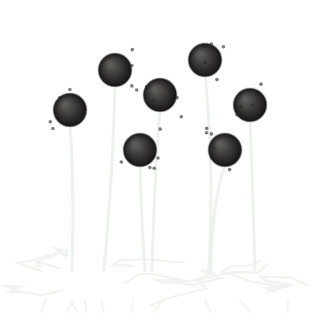
A fungus that covers stale bread with cottony white threads and black dot-like spore sacs.
🦠 See it in Organizma and playFact file
| Scientific name | Rhizopus stolonifer |
|---|---|
| Group | Fungi (Mucoromycota) |
| Size | Threads 5–15 µm wide; spore sacs 50–300 µm |
| Habitat | Bread, fruit, soil, decaying plants |
| Feeding | Secretes enzymes onto food, digests it outside and absorbs it |
| Movement | None; grows by spreading its threads |
| Reproduction | Airborne spores; sexual zygospores |
How does it live?
The body of a mould is a network of thin threads called hyphae (the mycelium). The hyphae spread into the food, release digestive enzymes and absorb the dissolved nutrients.
Black, round spore sacs form at the tips of upright hyphae. Each sac produces thousands of spores that drift in the air and start a new mould when they land on damp food.
Fun facts
- Mould spores are always in the air, which is why damp bread goes mouldy within days.
- The antibiotic penicillin was discovered in 1928 when another mould (Penicillium) spoiled a bacterial culture.
- Moulds are decomposers: they break down dead plant and animal matter and return nutrients to the soil.
In the game Organizma
Moulds are not in Organizma, but their single-celled relatives, the yeasts, are there as micro-creatures.
🦠 Play📺 Watch in screensaver modeGame vs. reality
- In the game: In the game organisms collect the genes of what they eat.
In reality: In reality genes are mostly passed from parent to offspring. Close parallels to getting genes from food are rare: horizontal gene transfer in bacteria, and a cell turning a swallowed alga into an organelle (endosymbiosis; this is how mitochondria and chloroplasts arose). - In the game: In the game you pick evolution cards while alive.
In reality: In reality an individual does not evolve during its life; mutations build up from generation to generation. The game's generation inheritance is therefore closer to reality.
Similar organisms
 YeastSaccharomyces cerevisiaeThe single-celled fungus that makes bread rise by turning sugar into carbon dioxide and alcohol.
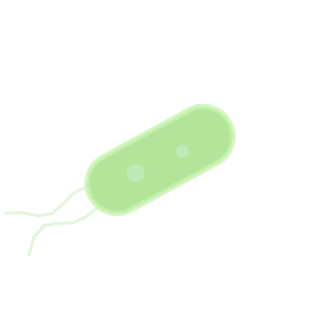 Bacillus (rod bacterium)Bacillus subtilisA rod-shaped bacterium of soil and water that turns into an almost indestructible spore in hard times.
 Hydrothermal vent bacteriaChemosynthetic bacteria and archaeaMicrobes that feed a whole ecosystem in the lightless deep sea by making energy from chemicals pouring out of vents.
This page is for general information; sizes and numbers vary by species, source and environment. The pictures are generated from the drawing code of the game Organizma and are simplified, game-like versions of the organisms. Bu sayfanın Türkçesi. Spotted a mistake? Let me know.