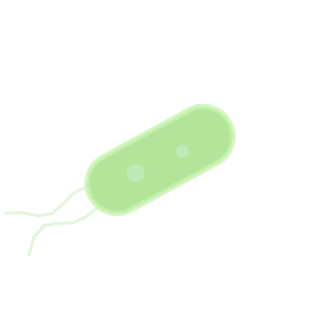
A rod-shaped bacterium of soil and water that turns into an almost indestructible spore in hard times.
🦠 See it in Organizma and playFact file
| Scientific name | Bacillus subtilis |
|---|---|
| Group | Bacteria (Bacillota) |
| Size | About 2–3 µm long, 0.7 µm wide |
| Habitat | Soil, decaying plants, fresh water |
| Feeding | Breaks down dead organic matter (decomposer) |
| Movement | Many flagella all over the body (peritrichous) |
| Reproduction | Binary fission; every 20–30 minutes in good conditions |
How does it live?
Bacillus bacteria are rod-shaped and swim by spinning flagella that stick out all over their bodies. In soil and water they break down dead plant and animal remains with the enzymes they release: the quiet workers of the nutrient cycle.
When food runs out, a thick-walled endospore forms inside the cell. The endospore survives drying, boiling, freezing and many chemicals, and becomes a dividing bacterium again when conditions improve.
Fun facts
- Endospores are thought to stay alive for centuries, by some claims much longer.
- Bacillus subtilis is used to make nattō, a fermented soybean dish from Japan.
- It is one of the most studied "model" organisms in bacterial biology; some enzymes in laundry detergents come from these bacteria.
In the game Organizma
The bacilli in Organizma are small, rod-shaped micro-creatures that multiply around decaying cells. Eating them adds a bacterial gene to your gene book.
🦠 Play📺 Watch in screensaver modeGame vs. reality
- In the game: In the game organisms collect the genes of what they eat.
In reality: In reality genes are mostly passed from parent to offspring. Close parallels to getting genes from food are rare: horizontal gene transfer in bacteria, and a cell turning a swallowed alga into an organelle (endosymbiosis; this is how mitochondria and chloroplasts arose). - In the game: In the game you pick evolution cards while alive.
In reality: In reality an individual does not evolve during its life; mutations build up from generation to generation. The game's generation inheritance is therefore closer to reality.
Similar organisms
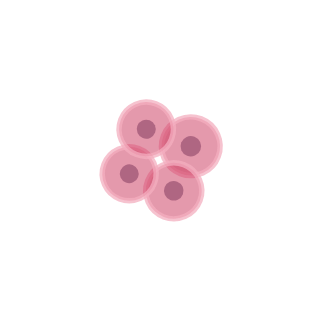 Coccus (round bacterium)Coccus (e.g. Micrococcus)Sphere-shaped bacteria that live alone, in pairs, chains, groups of four or grape-like clusters.
 Spirillum (spiral bacterium)Spirillum volutansA corkscrew-shaped bacterium of still water that swims with tufts of flagella at both ends.
 Vibrio (comma bacterium)VibrioA comma-shaped bacterium of seas and estuaries that swims very fast with a single flagellum.
This page is for general information; sizes and numbers vary by species, source and environment. The pictures are generated from the drawing code of the game Organizma and are simplified, game-like versions of the organisms. Bu sayfanın Türkçesi. Spotted a mistake? Let me know.