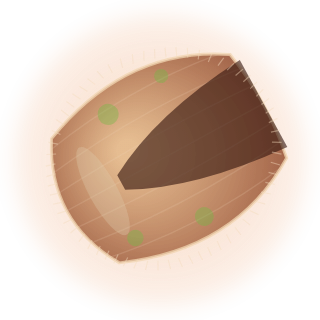
A purse-shaped single-celled giant approaching a millimetre that swallows other ciliates whole with its huge mouth.
🦠 See it in Organizma and playFact file
| Scientific name | Bursaria truncatella |
|---|---|
| Group | Ciliates (Ciliophora) |
| Size | About 0.5–1 mm; visible to the eye as a dot |
| Habitat | Clean ponds and lakes |
| Feeding | Other ciliates such as paramecia, rotifers |
| Movement | Slow and rotating, with cilia |
| Reproduction | Binary fission; forms cysts |
How does it live?
The body of Bursaria looks like a big purse open at the front. Its oral cavity is almost as deep as the body, and ciliary bands inside sweep water and prey in.
It can swallow whole paramecia and rotifers up to a quarter of its own length. Several food vacuoles can be seen in its body at once.
Fun facts
- It is one of the largest known single-celled predators.
- Its name means "purse, purse-like" in Latin.
- As a cyst it can wait for a long time and reopens when food becomes plentiful.
In the game Organizma
The giant Bursaria in Organizma is a rare giant creature; keep away from its mouth.
🦠 Play📺 Watch in screensaver modeGame vs. reality
- In the game: In the game organisms collect the genes of what they eat.
In reality: In reality genes are mostly passed from parent to offspring. Close parallels to getting genes from food are rare: horizontal gene transfer in bacteria, and a cell turning a swallowed alga into an organelle (endosymbiosis; this is how mitochondria and chloroplasts arose). - In the game: In the game you pick evolution cards while alive.
In reality: In reality an individual does not evolve during its life; mutations build up from generation to generation. The game's generation inheritance is therefore closer to reality.
Similar organisms
 ParameciumParamecium caudatumA slipper-shaped single cell that swims by beating thousands of cilia like oars and sweeps bacteria into its oral groove.
 DidiniumDidinium nasutumA barrel-shaped hunter that catches paramecia bigger than itself with a toxic snout and swallows them whole.
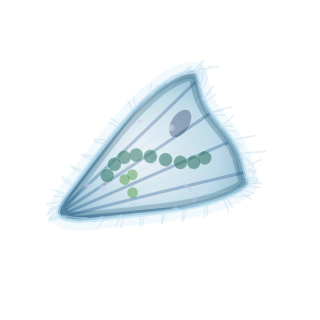 StentorStentor coeruleusA trumpet-shaped blue giant among single cells that stretches up to 2 millimetres and is visible to the naked eye.
This page is for general information; sizes and numbers vary by species, source and environment. The pictures are generated from the drawing code of the game Organizma and are simplified, game-like versions of the organisms. Bu sayfanın Türkçesi. Spotted a mistake? Let me know.