
A slipper-shaped single cell that swims by beating thousands of cilia like oars and sweeps bacteria into its oral groove.
🦠 See it in Organizma and playFact file
| Scientific name | Paramecium caudatum |
|---|---|
| Group | Ciliates (Ciliophora) |
| Size | About 0.18–0.3 mm |
| Habitat | Still fresh water rich in organic matter |
| Feeding | Bacteria, yeast and small algae, filtered through the oral groove |
| Movement | Thousands of cilia; about 1 mm per second, spinning on its own axis |
| Reproduction | Asexual binary fission; sexual conjugation |
How does it live?
The surface of a paramecium is covered with thousands of cilia that beat in regular waves, like oars. While pushing the cell forward, the cilia also drive water into the oral groove on the side of the body; bacteria are carried by this current to the cell mouth and packed into food vacuoles.
When it bumps into an obstacle it reverses its cilia, backs off, turns a little and swims forward again. This simple "bump, back up, turn" behaviour is a classic example of how a single cell explores its surroundings.
The cell has two kinds of nucleus: a large macronucleus that runs daily life and a small micronucleus used in reproduction. When two individuals line up side by side and swap pieces of their micronuclei, it is called conjugation, a primitive form of sexual reproduction.
Fun facts
- When threatened, it fires tiny harpoon-like darts called trichocysts from its surface.
- Its natural enemy is Didinium; the rise and fall of these two populations was the subject of G. F. Gause's famous predator–prey experiments in the 1930s.
- Its shape, rounded at the front and pointed at the back, earned it the nickname "slipper animalcule".
- It is one of the easiest organisms to see in a school microscope: just soak a handful of hay or a lettuce leaf in water for a few days.
In the game Organizma
In Organizma the Paramecium species is a fast, balanced swimmer. Small paramecium young roam as micro-creatures, and eating one adds a new gene to your gene book.
🦠 Play📺 Watch in screensaver modeGame vs. reality
- In the game: In the game organisms collect the genes of what they eat.
In reality: In reality genes are mostly passed from parent to offspring. Close parallels to getting genes from food are rare: horizontal gene transfer in bacteria, and a cell turning a swallowed alga into an organelle (endosymbiosis; this is how mitochondria and chloroplasts arose). - In the game: In the game you pick evolution cards while alive.
In reality: In reality an individual does not evolve during its life; mutations build up from generation to generation. The game's generation inheritance is therefore closer to reality.
Similar organisms
 DidiniumDidinium nasutumA barrel-shaped hunter that catches paramecia bigger than itself with a toxic snout and swallows them whole.
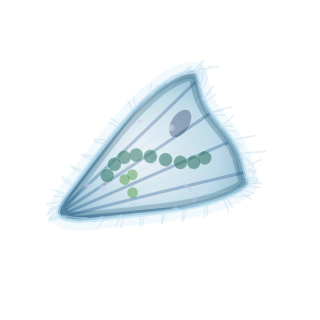 StentorStentor coeruleusA trumpet-shaped blue giant among single cells that stretches up to 2 millimetres and is visible to the naked eye.
 Vorticella (bell animalcule)VorticellaA bell-shaped ciliate on a spring-like stalk that makes one of the fastest movements known in cells.
This page is for general information; sizes and numbers vary by species, source and environment. The pictures are generated from the drawing code of the game Organizma and are simplified, game-like versions of the organisms. Bu sayfanın Türkçesi. Spotted a mistake? Let me know.