
A barrel-shaped hunter that catches paramecia bigger than itself with a toxic snout and swallows them whole.
🦠 See it in Organizma and playFact file
| Scientific name | Didinium nasutum |
|---|---|
| Group | Ciliates (Ciliophora) |
| Size | About 0.05–0.15 mm |
| Habitat | Fresh water wherever paramecia live |
| Feeding | Almost exclusively Paramecium |
| Movement | Fast and spinning, with two belts of cilia around the body |
| Reproduction | Binary fission; forms cysts when food runs out |
How does it live?
Didinium carries a proboscis at the front of its barrel-shaped body. When it hits its prey, toxicysts in the proboscis paralyse the victim and stick the two cells together.
It then opens its mouth astonishingly wide and swallows a paramecium larger than itself whole within a few minutes. A single didinium can eat several paramecia a day and divides quickly once fed.
When food runs out it turns into a thick-walled cyst and waits until paramecia multiply again.
Fun facts
- In 1934 the Russian biologist G. F. Gause put didinium and paramecium in the same tube and ran one of the first laboratory experiments on predator–prey relationships.
- In a simple tube the predator eats all its prey and then starves; but when a refuge and new immigrants are added, the two species live together and their populations oscillate.
- It is one of the few single cells that can swallow a cell bigger than itself.
In the game Organizma
The red hunters in Organizma are didinia: as in reality they hunt alone and go after growing cells. The occasional Didinium outbreak event is inspired by Gause's predator–prey cycle: when prey is plentiful, predators multiply too.
🦠 Play📺 Watch in screensaver modeGame vs. reality
- In the game: In the game didinium bites chunks off big cells.
In reality: In reality it paralyses its prey with its proboscis, swallows it whole and feeds almost only on paramecia. - In the game: In the game organisms collect the genes of what they eat.
In reality: In reality genes are mostly passed from parent to offspring. Close parallels to getting genes from food are rare: horizontal gene transfer in bacteria, and a cell turning a swallowed alga into an organelle (endosymbiosis; this is how mitochondria and chloroplasts arose). - In the game: In the game you pick evolution cards while alive.
In reality: In reality an individual does not evolve during its life; mutations build up from generation to generation. The game's generation inheritance is therefore closer to reality.
Similar organisms
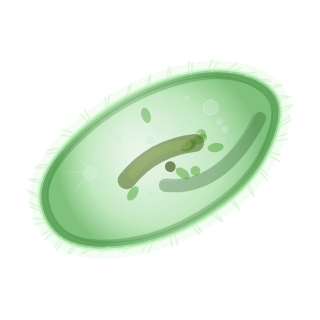 ParameciumParamecium caudatumA slipper-shaped single cell that swims by beating thousands of cilia like oars and sweeps bacteria into its oral groove.
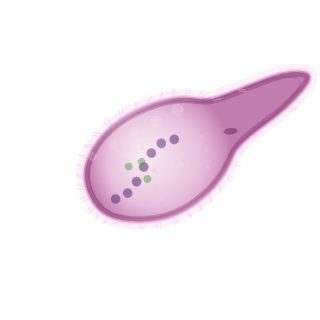 DileptusDileptus anserA swan-necked hunting ciliate that paralyses its prey with toxic darts along its long proboscis.
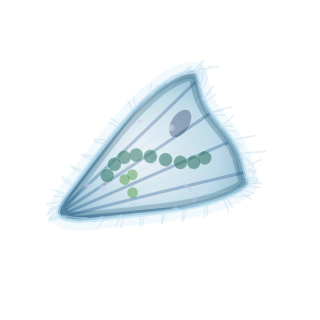 StentorStentor coeruleusA trumpet-shaped blue giant among single cells that stretches up to 2 millimetres and is visible to the naked eye.
This page is for general information; sizes and numbers vary by species, source and environment. The pictures are generated from the drawing code of the game Organizma and are simplified, game-like versions of the organisms. Bu sayfanın Türkçesi. Spotted a mistake? Let me know.