
A tiny, round, fast-growing green alga that lives inside many single-celled organisms as a partner.
🦠 See it in Organizma and playFact file
| Scientific name | Chlorella vulgaris |
|---|---|
| Group | Green algae (Trebouxiophyceae) |
| Size | About 2–10 µm |
| Habitat | Fresh water, damp soil; inside other organisms |
| Feeding | Photosynthesis |
| Movement | Non-motile |
| Reproduction | Forms 2–16 daughter cells (autospores) inside the cell |
How does it live?
Chlorella has a single cup-shaped chloroplast and multiplies very fast in light: one cell can split into four daughters within hours. It is a major source of the green colour of pond water.
It lives in partnership with many organisms: the green paramecium (Paramecium bursaria), the green hydra and some sponges carry chlorella inside them; the alga gives them sugar and they shelter it.
Fun facts
- In the 1950s it was studied as a source of oxygen and food for space travel.
- Today it is sold as a food supplement.
- The alga used in the experiments that worked out the dark reactions of photosynthesis (the Calvin cycle) was a chlorella species.
In the game Organizma
The small green algae in Organizma are the most common plankton food. Algae you swallow sometimes live on inside your cell (endosymbiosis), based on the real chlorella partnership.
🦠 Play📺 Watch in screensaver modeGame vs. reality
- In the game: In the game organisms collect the genes of what they eat.
In reality: In reality genes are mostly passed from parent to offspring. Close parallels to getting genes from food are rare: horizontal gene transfer in bacteria, and a cell turning a swallowed alga into an organelle (endosymbiosis; this is how mitochondria and chloroplasts arose). - In the game: In the game you pick evolution cards while alive.
In reality: In reality an individual does not evolve during its life; mutations build up from generation to generation. The game's generation inheritance is therefore closer to reality.
Similar organisms
 ScenedesmusScenedesmus (Desmodesmus)A small green algal colony of four cells side by side, with spines at the ends.
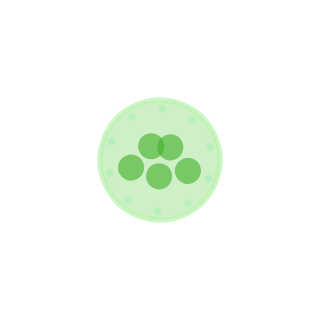 VolvoxVolvoxA green, rolling ball of thousands of flagellated cells that carries daughter spheres inside it.
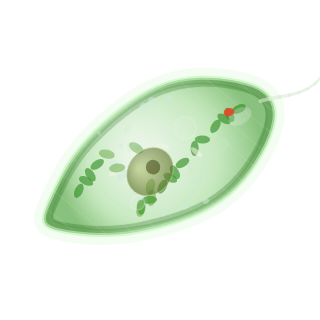 EuglenaEuglena gracilisA flagellate that photosynthesises in light, absorbs food in the dark and finds the light with its red eyespot.
This page is for general information; sizes and numbers vary by species, source and environment. The pictures are generated from the drawing code of the game Organizma and are simplified, game-like versions of the organisms. Bu sayfanın Türkçesi. Spotted a mistake? Let me know.