
A green, rolling ball of thousands of flagellated cells that carries daughter spheres inside it.
🦠 See it in Organizma and playFact file
| Scientific name | Volvox |
|---|---|
| Group | Green algae (Chlorophyta) |
| Size | Colony about 0.35–1 mm; a green dot to the naked eye |
| Habitat | Clean lakes, ponds and puddles |
| Feeding | Photosynthesis |
| Movement | The cells beat their flagella in sync and the colony rolls on its axis |
| Reproduction | Daughter colonies develop inside; sexual reproduction also occurs |
How does it live?
Volvox is made of 500 to 50,000 tiny flagellated cells arranged on the surface of a jelly-filled sphere. Each cell has two flagella and an eyespot; because the flagella beat in harmony, the whole colony rolls towards the light.
Inside the sphere are daughter colonies, each grown from one of a few large cells specialised for reproduction. When they mature, the daughters tear through the mother's wall and swim away.
Fun facts
- Scientists use volvox as a model organism for understanding the step from single-celled to multicellular life: its cells share out the work.
- While developing, daughter colonies turn themselves inside out like a sock; this is called inversion.
- It takes its name from the Latin volvere, "to roll".
In the game Organizma
In Organizma Volvox is a green micro-creature with daughter spheres spinning inside; eating one adds a gene to your gene book.
🦠 Play📺 Watch in screensaver modeGame vs. reality
- In the game: In the game organisms collect the genes of what they eat.
In reality: In reality genes are mostly passed from parent to offspring. Close parallels to getting genes from food are rare: horizontal gene transfer in bacteria, and a cell turning a swallowed alga into an organelle (endosymbiosis; this is how mitochondria and chloroplasts arose). - In the game: In the game you pick evolution cards while alive.
In reality: In reality an individual does not evolve during its life; mutations build up from generation to generation. The game's generation inheritance is therefore closer to reality.
Similar organisms
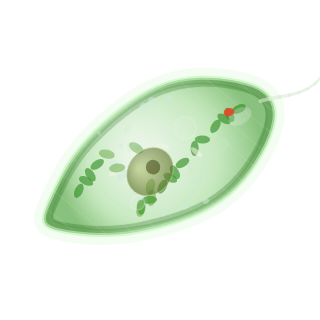 EuglenaEuglena gracilisA flagellate that photosynthesises in light, absorbs food in the dark and finds the light with its red eyespot.
 DiatomBacillariophytaAn alga that lives inside two halves of a glass box and produces a large share of Earth's oxygen.
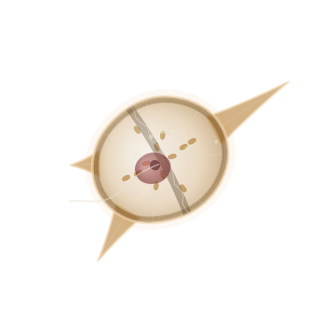 CeratiumCeratium hirundinellaA light-feeding dinoflagellate armoured with cellulose plates that drifts on its long horns.
This page is for general information; sizes and numbers vary by species, source and environment. The pictures are generated from the drawing code of the game Organizma and are simplified, game-like versions of the organisms. Bu sayfanın Türkçesi. Spotted a mistake? Let me know.