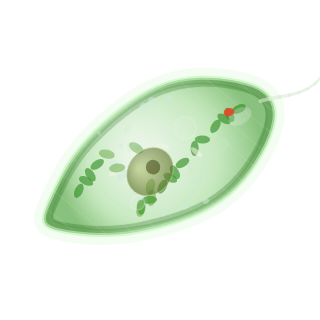
A flagellate that photosynthesises in light, absorbs food in the dark and finds the light with its red eyespot.
🦠 See it in Organizma and playFact file
| Scientific name | Euglena gracilis |
|---|---|
| Group | Euglenozoa, flagellated protist |
| Size | About 35–60 µm |
| Habitat | Ponds, puddles and nutrient-rich fresh water |
| Feeding | Photosynthesis in light; absorbs organic matter in the dark (mixotroph) |
| Movement | A long flagellum at the front; also crawls by contracting and relaxing its body |
| Reproduction | Lengthwise binary fission |
How does it live?
A euglena cell is packed with green chloroplasts; in light it makes its own food by photosynthesis, like a plant. Without light it can survive by taking up dissolved organic matter from the water. This two-way feeding is called mixotrophy and makes euglena the textbook "half plant, half animal".
At its front end sits an orange-red eyespot (stigma) next to a light-sensitive receptor. As the eyespot casts a shadow on the receptor, the cell "senses" the direction of the light and steers towards the bright side with its flagellum.
Thanks to its pellicle, a flexible layer of protein strips under the surface, euglena can squeeze and stretch its body like a worm; this is called euglenoid movement.
Fun facts
- When they become very numerous in puddles they can turn the water green, and some species red.
- Scientists study euglena for producing biofuel and food supplements (a storage sugar called paramylon).
- Its mix of plant-like and animal-like features was one of the examples that showed, in the 19th century, that dividing life into just two kingdoms was not enough.
In the game Organizma
In Organizma the Euglena species is drawn with its red eyespot and flagellum. The Symbiont specialisation path is also inspired by euglena: you gain energy by yourself in the light.
🦠 Play📺 Watch in screensaver modeGame vs. reality
- In the game: In the game the symbiont path also gives a protective shield.
In reality: In reality living on light gives no protection; the shield is purely a game mechanic. - In the game: In the game organisms collect the genes of what they eat.
In reality: In reality genes are mostly passed from parent to offspring. Close parallels to getting genes from food are rare: horizontal gene transfer in bacteria, and a cell turning a swallowed alga into an organelle (endosymbiosis; this is how mitochondria and chloroplasts arose). - In the game: In the game you pick evolution cards while alive.
In reality: In reality an individual does not evolve during its life; mutations build up from generation to generation. The game's generation inheritance is therefore closer to reality.
Similar organisms
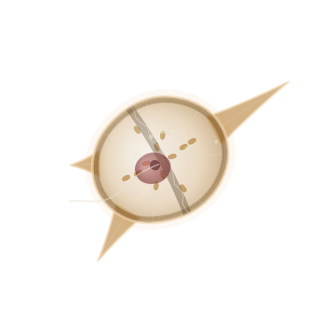 CeratiumCeratium hirundinellaA light-feeding dinoflagellate armoured with cellulose plates that drifts on its long horns.
 VolvoxVolvoxA green, rolling ball of thousands of flagellated cells that carries daughter spheres inside it.
 DiatomBacillariophytaAn alga that lives inside two halves of a glass box and produces a large share of Earth's oxygen.
This page is for general information; sizes and numbers vary by species, source and environment. The pictures are generated from the drawing code of the game Organizma and are simplified, game-like versions of the organisms. Bu sayfanın Türkçesi. Spotted a mistake? Let me know.