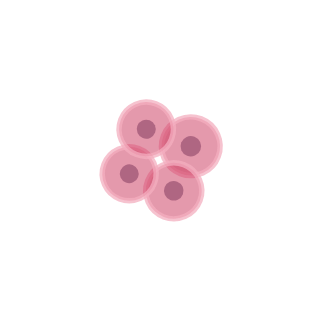
Sphere-shaped bacteria that live alone, in pairs, chains, groups of four or grape-like clusters.
🦠 See it in Organizma and playFact file
| Scientific name | Coccus (e.g. Micrococcus) |
|---|---|
| Group | Bacteria; a name based on shape |
| Size | About 0.5–1.5 µm across |
| Habitat | Water, soil, air, skin |
| Feeding | Most are decomposers; some live on other organisms |
| Movement | Most cannot move and drift with currents |
| Reproduction | Binary fission; the plane of division sets the cluster shape |
How does it live?
"Coccus" means "seed, berry" in Greek and is the general name for round bacteria. If dividing cells do not separate, they form shaped clusters: always dividing in the same direction makes chains (streptococci), two planes make groups of four, three planes make cube-shaped packets (sarcina), random planes make grape bunches (staphylococci).
Under the microscope, this arrangement is one of the first clues for identifying a bacterium, which is why labs look at the shape and arrangement of cells together with staining.
Fun facts
- The harmless Micrococcus and Staphylococcus epidermidis living on our skin are cocci.
- A round shape means a small surface for its volume, so slightly better resistance to drying out.
- Some cocci cause disease, but most are harmless and take part in nature's nutrient cycles.
In the game Organizma
The cocci in Organizma are among the smallest micro-creatures; some of your first food when you are small.
🦠 Play📺 Watch in screensaver modeGame vs. reality
- In the game: In the game organisms collect the genes of what they eat.
In reality: In reality genes are mostly passed from parent to offspring. Close parallels to getting genes from food are rare: horizontal gene transfer in bacteria, and a cell turning a swallowed alga into an organelle (endosymbiosis; this is how mitochondria and chloroplasts arose). - In the game: In the game you pick evolution cards while alive.
In reality: In reality an individual does not evolve during its life; mutations build up from generation to generation. The game's generation inheritance is therefore closer to reality.
Similar organisms
 Streptococcus (chain bacterium)StreptococcusRound bacteria that stay stuck together after dividing, forming chains like strings of beads.
 Sarcina (packet coccus)SarcinaRound bacteria that divide in three planes and form cube-shaped packets of eight, stacked like parcels.
 Bacillus (rod bacterium)Bacillus subtilisA rod-shaped bacterium of soil and water that turns into an almost indestructible spore in hard times.
This page is for general information; sizes and numbers vary by species, source and environment. The pictures are generated from the drawing code of the game Organizma and are simplified, game-like versions of the organisms. Bu sayfanın Türkçesi. Spotted a mistake? Let me know.