
Round bacteria that divide in three planes and form cube-shaped packets of eight, stacked like parcels.
🦠 See it in Organizma and playFact file
| Scientific name | Sarcina |
|---|---|
| Group | Bacteria (Bacillota) |
| Size | Cells 1.8–3 µm; packets several times larger |
| Habitat | Soil, marshes, animal stomachs |
| Feeding | Ferments sugars without oxygen |
| Movement | Non-motile |
| Reproduction | Successive divisions in three perpendicular planes |
How does it live?
At each division a sarcina cell picks a plane at right angles to the previous one. Because the cells do not separate, they form pairs, then fours, then cube-shaped packets of eight.
It tolerates acidic, oxygen-free places and ferments sugars into gas and organic acids. Some species can even live in very acidic places such as the stomach.
Fun facts
- The name comes from the Latin sarcina, "bundle, pack".
- Cocci in fours are called "tetrads"; cubes of eight are the "sarcina arrangement".
- It is the classic textbook example of bacterial arrangements.
In the game Organizma
Game vs. reality
- In the game: In the game organisms collect the genes of what they eat.
In reality: In reality genes are mostly passed from parent to offspring. Close parallels to getting genes from food are rare: horizontal gene transfer in bacteria, and a cell turning a swallowed alga into an organelle (endosymbiosis; this is how mitochondria and chloroplasts arose). - In the game: In the game you pick evolution cards while alive.
In reality: In reality an individual does not evolve during its life; mutations build up from generation to generation. The game's generation inheritance is therefore closer to reality.
Similar organisms
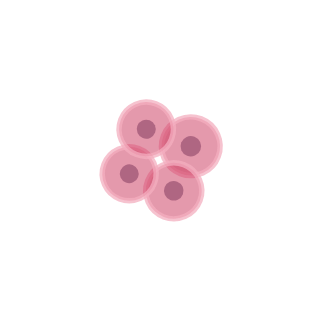 Coccus (round bacterium)Coccus (e.g. Micrococcus)Sphere-shaped bacteria that live alone, in pairs, chains, groups of four or grape-like clusters.
 Streptococcus (chain bacterium)StreptococcusRound bacteria that stay stuck together after dividing, forming chains like strings of beads.
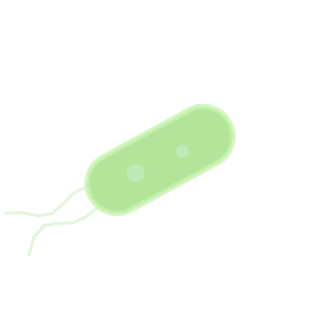 Bacillus (rod bacterium)Bacillus subtilisA rod-shaped bacterium of soil and water that turns into an almost indestructible spore in hard times.
This page is for general information; sizes and numbers vary by species, source and environment. The pictures are generated from the drawing code of the game Organizma and are simplified, game-like versions of the organisms. Bu sayfanın Türkçesi. Spotted a mistake? Let me know.