
An alga that lives inside two halves of a glass box and produces a large share of Earth's oxygen.
🦠 See it in Organizma and playFact file
| Scientific name | Bacillariophyta |
|---|---|
| Group | Diatoms (Bacillariophyta) |
| Size | About 2–200 µm |
| Habitat | Almost all fresh and salt water, damp soil and even ice |
| Feeding | Photosynthesis |
| Movement | Most drift; boat-shaped ones glide on the mucus they secrete |
| Reproduction | Binary fission; cells that shrink over time restore their size by sexual reproduction |
How does it live?
A diatom cell lives inside a silica (glass) shell called a frustule, made of two halves that fit together like a box and its lid. The surface of the shell is decorated with fine pores and lines in patterns that differ from species to species.
There are two main shapes: round centric diatoms and long, boat-shaped pennate diatoms. Boat-shaped ones can glide over surfaces by pushing out mucus through a slit in the shell.
At each division one daughter cell gets the mother's smaller lid, so the average size of the population gradually shrinks. When cells reach a certain size, sexual reproduction takes place and a large cell is formed again.
Fun facts
- Diatoms carry out about a fifth of all photosynthesis on Earth: the oxygen in one of every five breaths you take comes from them.
- The shells of dead diatoms pile up into diatomaceous earth, used in filters, toothpaste and fine abrasives.
- The perfectly regular patterns on their shells were once used to test the sharpness of microscope lenses.
In the game Organizma
In Organizma boat diatoms and disc diatoms are part of the green plankton; they are most of your first food for growing.
🦠 Play📺 Watch in screensaver modeGame vs. reality
- In the game: In the game organisms collect the genes of what they eat.
In reality: In reality genes are mostly passed from parent to offspring. Close parallels to getting genes from food are rare: horizontal gene transfer in bacteria, and a cell turning a swallowed alga into an organelle (endosymbiosis; this is how mitochondria and chloroplasts arose). - In the game: In the game you pick evolution cards while alive.
In reality: In reality an individual does not evolve during its life; mutations build up from generation to generation. The game's generation inheritance is therefore closer to reality.
Similar organisms
 CoccolithophoreEmiliania huxleyi and relativesA tiny alga covered in chalk scales that turns the sea milky blue, visible from space, when it blooms.
 VolvoxVolvoxA green, rolling ball of thousands of flagellated cells that carries daughter spheres inside it.
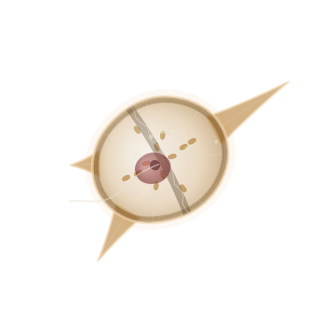 CeratiumCeratium hirundinellaA light-feeding dinoflagellate armoured with cellulose plates that drifts on its long horns.
This page is for general information; sizes and numbers vary by species, source and environment. The pictures are generated from the drawing code of the game Organizma and are simplified, game-like versions of the organisms. Bu sayfanın Türkçesi. Spotted a mistake? Let me know.