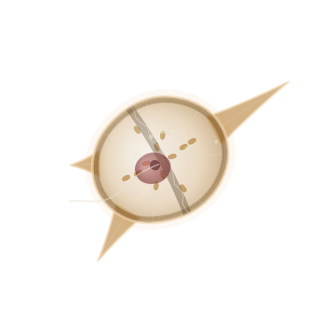
A light-feeding dinoflagellate armoured with cellulose plates that drifts on its long horns.
🦠 See it in Organizma and playFact file
| Scientific name | Ceratium hirundinella |
|---|---|
| Group | Dinoflagellates (Dinoflagellata) |
| Size | About 0.1–0.45 mm including horns |
| Habitat | Lake and sea plankton; abundant in summer |
| Feeding | Photosynthesis; some species also swallow small organisms |
| Movement | Two flagella: one wraps around the body like a belt, one trails behind |
| Reproduction | Binary fission; cysts in hard times |
How does it live?
Ceratium wears an armour of cellulose plates called a theca. One front and two or three rear horns extending from it enlarge the surface of the cell and slow its sinking in water.
It has two flagella: one runs along a groove around the body like a belt and spins the cell, the other trails behind and pushes it forward. That is why dinoflagellates move through the water spinning like tops.
It photosynthesises with its chloroplasts and is a major part of summer plankton in lakes. When it multiplies greatly it can colour the water brown.
Fun facts
- The name dinoflagellate comes from Greek for "whirling whip".
- Its horns can be shorter in warm water and longer in cold water: its shape changes with the density of the water.
- Some dinoflagellate relatives cause toxic "red tides", others make waves glow at night (see Noctiluca).
In the game Organizma
In Organizma the Ceratium species is drawn with three long horns and is more efficient in light. Small dinoflagellates also spin through the water as micro-creatures.
🦠 Play📺 Watch in screensaver modeGame vs. reality
- In the game: In the game organisms collect the genes of what they eat.
In reality: In reality genes are mostly passed from parent to offspring. Close parallels to getting genes from food are rare: horizontal gene transfer in bacteria, and a cell turning a swallowed alga into an organelle (endosymbiosis; this is how mitochondria and chloroplasts arose). - In the game: In the game you pick evolution cards while alive.
In reality: In reality an individual does not evolve during its life; mutations build up from generation to generation. The game's generation inheritance is therefore closer to reality.
Similar organisms
 Noctiluca (sea sparkle)Noctiluca scintillansA giant dinoflagellate that flashes blue light when disturbed and makes waves glow at night.
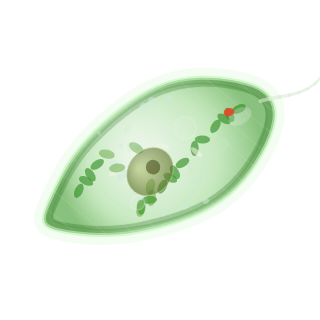 EuglenaEuglena gracilisA flagellate that photosynthesises in light, absorbs food in the dark and finds the light with its red eyespot.
 DiatomBacillariophytaAn alga that lives inside two halves of a glass box and produces a large share of Earth's oxygen.
This page is for general information; sizes and numbers vary by species, source and environment. The pictures are generated from the drawing code of the game Organizma and are simplified, game-like versions of the organisms. Bu sayfanın Türkçesi. Spotted a mistake? Let me know.