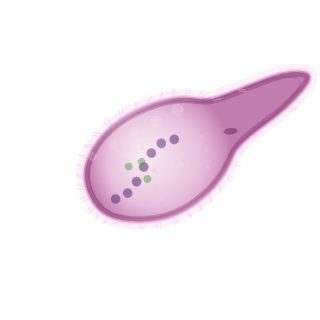
A swan-necked hunting ciliate that paralyses its prey with toxic darts along its long proboscis.
🦠 See it in Organizma and playFact file
| Scientific name | Dileptus anser |
|---|---|
| Group | Ciliates (Ciliophora) |
| Size | About 0.25–0.5 mm |
| Habitat | Fresh water, ponds and marshes |
| Feeding | Other ciliates, flagellates and tiny animals |
| Movement | Glides on its cilia, sweeping its proboscis from side to side to find prey |
| Reproduction | Binary fission |
How does it live?
The front of the dileptus body has become a long, flexible proboscis. Toxicysts lined up along one edge discharge venom into small organisms they touch and paralyse them.
The mouth sits at the base of the proboscis. Paralysed prey is carried to the mouth and swallowed. This way of hunting makes it work like a moving trap in the water.
Fun facts
- Latin anser means "goose": its long proboscis was compared to a goose's neck.
- Even if the proboscis is cut off, the cell can regrow it.
- Together with Didinium, it is one of the best examples of how single cells can be effective predators.
In the game Organizma
In Organizma the Dileptus species is drawn with its long proboscis. The venom dart of the Hunter specialisation path is inspired by the toxic darts of dileptus.
🦠 Play📺 Watch in screensaver modeGame vs. reality
- In the game: In the game the hunter path fires its venom dart at a distance.
In reality: In reality toxicysts only discharge when the proboscis touches the prey; there is no shooting at range. - In the game: In the game organisms collect the genes of what they eat.
In reality: In reality genes are mostly passed from parent to offspring. Close parallels to getting genes from food are rare: horizontal gene transfer in bacteria, and a cell turning a swallowed alga into an organelle (endosymbiosis; this is how mitochondria and chloroplasts arose). - In the game: In the game you pick evolution cards while alive.
In reality: In reality an individual does not evolve during its life; mutations build up from generation to generation. The game's generation inheritance is therefore closer to reality.
Similar organisms
 DidiniumDidinium nasutumA barrel-shaped hunter that catches paramecia bigger than itself with a toxic snout and swallows them whole.
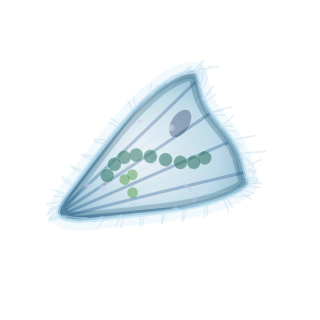 StentorStentor coeruleusA trumpet-shaped blue giant among single cells that stretches up to 2 millimetres and is visible to the naked eye.
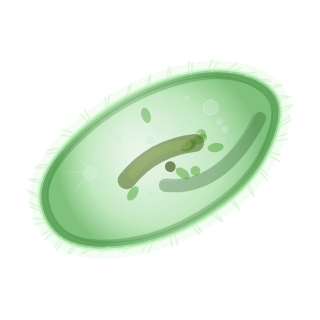 ParameciumParamecium caudatumA slipper-shaped single cell that swims by beating thousands of cilia like oars and sweeps bacteria into its oral groove.
This page is for general information; sizes and numbers vary by species, source and environment. The pictures are generated from the drawing code of the game Organizma and are simplified, game-like versions of the organisms. Bu sayfanın Türkçesi. Spotted a mistake? Let me know.