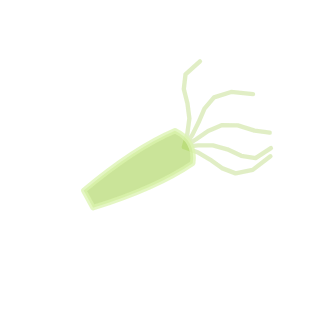
A tiny freshwater animal that hunts with venomous capsules on its tentacles and is thought not to age.
🦠 See it in Organizma and playFact file
| Scientific name | Hydra |
|---|---|
| Group | Cnidarians (Cnidaria), Hydrozoa |
| Size | From a few millimetres up to 1–2 cm |
| Habitat | Attached to plants in clean lakes and ponds |
| Feeding | Water fleas, copepods and small larvae |
| Movement | Mostly attached; moves by somersaulting or gliding |
| Reproduction | Budding; sexual in hard times |
How does it live?
At the tip of the hydra's tube-shaped body is a mouth surrounded by 5–12 tentacles. Cells on the tentacles called cnidocytes contain venomous stinging capsules (nematocysts) that fire on contact.
When a water flea brushes a tentacle, the capsules fire, the prey is paralysed and the tentacles carry it to the mouth. A hydra can swallow prey almost as big as itself.
In good conditions a small offspring buds from the side of its body and breaks off to live on its own once it has grown.
Fun facts
- It is named after the mythical monster Hydra, which grew a new head for each one cut off: a hydra cut into pieces can turn each piece into a new hydra.
- In hydras followed in the lab for years, the death rate did not rise with age; that is why they are given as an example of "non-ageing" animals.
- It belongs to the same large group as jellyfish and corals.
In the game Organizma
In Organizma small hydra young roam as micro-creatures with waving tentacles.
🦠 Play📺 Watch in screensaver modeGame vs. reality
- In the game: In the game organisms collect the genes of what they eat.
In reality: In reality genes are mostly passed from parent to offspring. Close parallels to getting genes from food are rare: horizontal gene transfer in bacteria, and a cell turning a swallowed alga into an organelle (endosymbiosis; this is how mitochondria and chloroplasts arose). - In the game: In the game you pick evolution cards while alive.
In reality: In reality an individual does not evolve during its life; mutations build up from generation to generation. The game's generation inheritance is therefore closer to reality.
Similar organisms
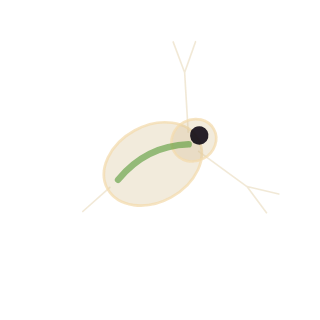 Water fleaDaphniaA tiny filter-feeding crustacean whose beating heart can be seen through its transparent shell.
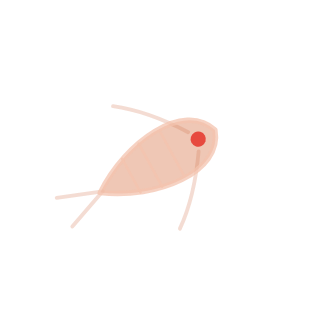 CopepodCopepodaA tiny one-eyed crustacean that is among the most numerous animals on Earth.
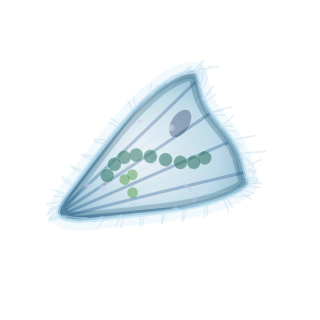 StentorStentor coeruleusA trumpet-shaped blue giant among single cells that stretches up to 2 millimetres and is visible to the naked eye.
This page is for general information; sizes and numbers vary by species, source and environment. The pictures are generated from the drawing code of the game Organizma and are simplified, game-like versions of the organisms. Bu sayfanın Türkçesi. Spotted a mistake? Let me know.