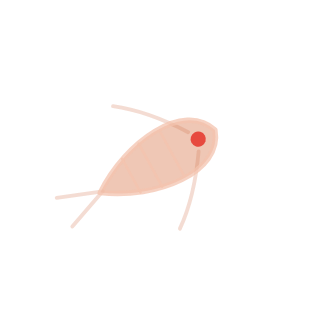
A tiny one-eyed crustacean that is among the most numerous animals on Earth.
🦠 See it in Organizma and playFact file
| Scientific name | Copepoda |
|---|---|
| Group | Crustaceans (Crustacea), Copepoda |
| Size | Mostly 0.5–2 mm |
| Habitat | Almost every sea and fresh water, from the deep ocean to puddles |
| Feeding | Diatoms and other phytoplankton; some are predators |
| Movement | Jumps using its long antennae and legs |
| Reproduction | Sexual; a nauplius larva hatches from the egg |
How does it live?
Copepods have a teardrop-shaped body, a long pair of antennae and a single naupliar eye in the middle of the head. By beating their legs together they can jump in a few thousandths of a second and escape predators.
Because they eat phytoplankton such as diatoms and pass that energy on to fish, whales and seabirds, they are one of the most important links in the ocean food chain.
Many species hide in the dark depths by day and rise to the surface at night to feed. This diel vertical migration is considered the largest animal movement on the planet.
Fun facts
- They are among the most numerous multicellular animal groups on Earth; by some estimates trillions swim in the seas at any moment.
- The larva that hatches from the egg is called a nauplius; it passes through six nauplius and five copepodite stages, moulting each time, before becoming an adult.
- Through the carbon they carry to the depths, they also play a role in regulating the climate.
In the game Organizma
In Organizma copepods and their nauplius larvae jump through the water as micro-creatures.
🦠 Play📺 Watch in screensaver modeGame vs. reality
- In the game: In the game organisms collect the genes of what they eat.
In reality: In reality genes are mostly passed from parent to offspring. Close parallels to getting genes from food are rare: horizontal gene transfer in bacteria, and a cell turning a swallowed alga into an organelle (endosymbiosis; this is how mitochondria and chloroplasts arose). - In the game: In the game you pick evolution cards while alive.
In reality: In reality an individual does not evolve during its life; mutations build up from generation to generation. The game's generation inheritance is therefore closer to reality.
Similar organisms
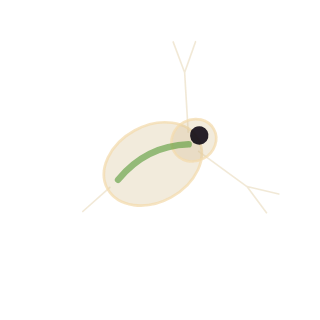 Water fleaDaphniaA tiny filter-feeding crustacean whose beating heart can be seen through its transparent shell.
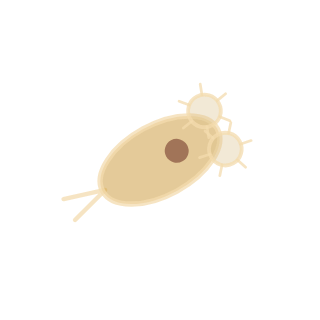 Rotifer (wheel animal)RotiferaA tiny animal whose ring of cilia looks like a spinning wheel, and which can survive frozen for thousands of years.
 Noctiluca (sea sparkle)Noctiluca scintillansA giant dinoflagellate that flashes blue light when disturbed and makes waves glow at night.
This page is for general information; sizes and numbers vary by species, source and environment. The pictures are generated from the drawing code of the game Organizma and are simplified, game-like versions of the organisms. Bu sayfanın Türkçesi. Spotted a mistake? Let me know.