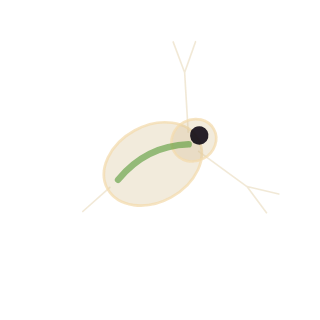
A tiny filter-feeding crustacean whose beating heart can be seen through its transparent shell.
🦠 See it in Organizma and playFact file
| Scientific name | Daphnia |
|---|---|
| Group | Crustaceans (Crustacea), Cladocera |
| Size | About 0.2–5 mm |
| Habitat | Lakes, ponds and puddles |
| Feeding | Filters algae and bacteria with its legs |
| Movement | Rows with its large antennae, in little hops |
| Reproduction | Asexual (parthenogenesis) in good conditions; sexual in hard times |
How does it live?
The body of a water flea sits inside an almost transparent shell; under the microscope you can clearly see its heart beating, its gut filling with green algae and eggs developing in the brood pouch on its back.
Fine hairs on its legs keep water flowing and filter it; water fleas can filter a large share of a pond's water in a single day. That is why they play a big part in keeping water clear.
In good conditions females produce only female young without mating. When the water cools and food runs short, males appear and tough ephippium eggs are formed that can survive drought and freezing.
Fun facts
- They are a standard test animal in water quality and toxicity tests: their sensitivity gives early warning of pollution.
- They are widely used as fish food in aquariums.
- When they smell a predator, some species grow a "helmet" on their head or a long spine on their tail.
In the game Organizma
In Organizma small water flea young roam as micro-creatures, drawn with big eyes and oar-like antennae.
🦠 Play📺 Watch in screensaver modeGame vs. reality
- In the game: In the game organisms collect the genes of what they eat.
In reality: In reality genes are mostly passed from parent to offspring. Close parallels to getting genes from food are rare: horizontal gene transfer in bacteria, and a cell turning a swallowed alga into an organelle (endosymbiosis; this is how mitochondria and chloroplasts arose). - In the game: In the game you pick evolution cards while alive.
In reality: In reality an individual does not evolve during its life; mutations build up from generation to generation. The game's generation inheritance is therefore closer to reality.
Similar organisms
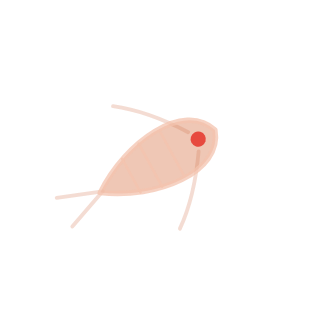 CopepodCopepodaA tiny one-eyed crustacean that is among the most numerous animals on Earth.
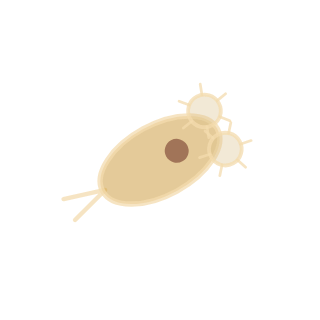 Rotifer (wheel animal)RotiferaA tiny animal whose ring of cilia looks like a spinning wheel, and which can survive frozen for thousands of years.
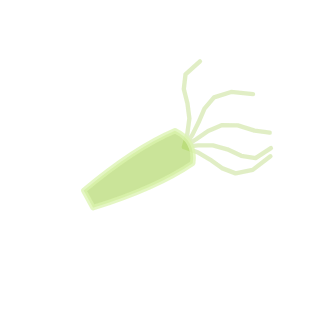 HydraHydraA tiny freshwater animal that hunts with venomous capsules on its tentacles and is thought not to age.
This page is for general information; sizes and numbers vary by species, source and environment. The pictures are generated from the drawing code of the game Organizma and are simplified, game-like versions of the organisms. Bu sayfanın Türkçesi. Spotted a mistake? Let me know.