
A giant dinoflagellate that flashes blue light when disturbed and makes waves glow at night.
🦠 See it in Organizma and playFact file
| Scientific name | Noctiluca scintillans |
|---|---|
| Group | Dinoflagellates (Dinoflagellata) |
| Size | About 0.2–2 mm; visible to the naked eye |
| Habitat | Coastal waters of temperate and warm seas |
| Feeding | Swallows plankton, diatoms and eggs; the green form also gets food from algae inside it |
| Movement | Mostly passive drifting; collects prey with a single tentacle |
| Reproduction | Binary fission; sexual reproduction |
How does it live?
Noctiluca is a transparent, balloon-shaped cell that is mostly a fluid-filled sac. This structure keeps it floating near the surface.
When the cell is disturbed by a wave, an oar or a swimmer, it gives a short flash of blue light through the luciferin–luciferase reaction. When millions of cells are together, the sea glows like neon at night.
By day, where it is very abundant, it can colour the water pink-orange and create a red tide.
Fun facts
- Its name means "night light" in Latin; in English it is known as sea sparkle.
- The light is probably used to startle the small animals trying to eat it, or to attract larger animals that hunt those grazers (the "burglar alarm" hypothesis).
- Many photos of glowing waves from the Maldives, Taiwan and California show Noctiluca.
In the game Organizma
In Organizma Noctiluca lives only in the dark deep water and glows. Eating it gives a rare deep-water gene.
🦠 Play📺 Watch in screensaver modeGame vs. reality
- In the game: In the game organisms collect the genes of what they eat.
In reality: In reality genes are mostly passed from parent to offspring. Close parallels to getting genes from food are rare: horizontal gene transfer in bacteria, and a cell turning a swallowed alga into an organelle (endosymbiosis; this is how mitochondria and chloroplasts arose). - In the game: In the game you pick evolution cards while alive.
In reality: In reality an individual does not evolve during its life; mutations build up from generation to generation. The game's generation inheritance is therefore closer to reality.
Similar organisms
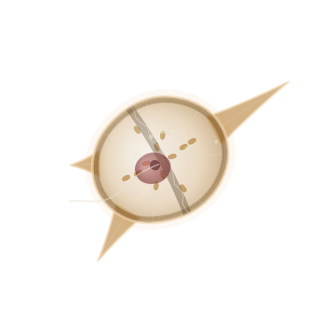 CeratiumCeratium hirundinellaA light-feeding dinoflagellate armoured with cellulose plates that drifts on its long horns.
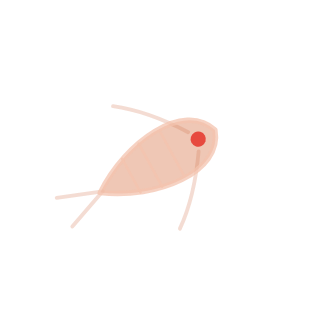 CopepodCopepodaA tiny one-eyed crustacean that is among the most numerous animals on Earth.
 CoccolithophoreEmiliania huxleyi and relativesA tiny alga covered in chalk scales that turns the sea milky blue, visible from space, when it blooms.
This page is for general information; sizes and numbers vary by species, source and environment. The pictures are generated from the drawing code of the game Organizma and are simplified, game-like versions of the organisms. Bu sayfanın Türkçesi. Spotted a mistake? Let me know.