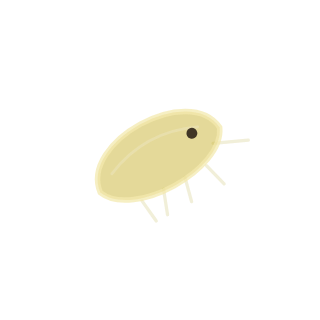
A small crustacean that hides its whole body inside a two-valved shell like a clam.
🦠 See it in Organizma and playFact file
| Scientific name | Ostracoda |
|---|---|
| Group | Crustaceans (Crustacea), Ostracoda |
| Size | Most 0.5–3 mm |
| Habitat | Fresh water, sea, damp soil; mostly on the bottom |
| Feeding | Algae, bacteria, detritus; some are predators |
| Movement | Swims or walks with antennae poked out between the valves |
| Reproduction | Sexual; some species without males (parthenogenesis) |
How does it live?
An ostracod's body is inside a hinged, two-valved, chalky shell. It opens the valves slightly to stick out its antennae and legs, and snaps the shell shut in danger.
Most species live on lake and sea floors eating detritus and algae. Their shells are preserved in sediment after death.
Fun facts
- Their fossils go back about 450 million years; geologists use them to date rocks and estimate ancient water temperatures.
- Some marine ostracods glow blue; Japanese soldiers in World War II are said to have moistened dried ostracods to use as a dim light.
- Some of the largest known sperm cells in the animal kingdom are found in ostracods, longer than the animal itself.
In the game Organizma
The ostracods in Organizma are micro-creatures that roam near the bottom in their two-valved shells.
🦠 Play📺 Watch in screensaver modeGame vs. reality
- In the game: In the game organisms collect the genes of what they eat.
In reality: In reality genes are mostly passed from parent to offspring. Close parallels to getting genes from food are rare: horizontal gene transfer in bacteria, and a cell turning a swallowed alga into an organelle (endosymbiosis; this is how mitochondria and chloroplasts arose). - In the game: In the game you pick evolution cards while alive.
In reality: In reality an individual does not evolve during its life; mutations build up from generation to generation. The game's generation inheritance is therefore closer to reality.
Similar organisms
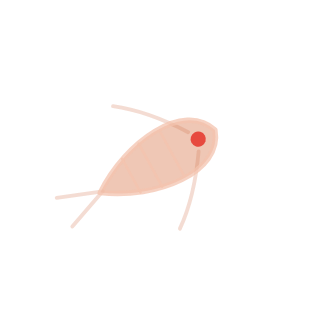 CopepodCopepodaA tiny one-eyed crustacean that is among the most numerous animals on Earth.
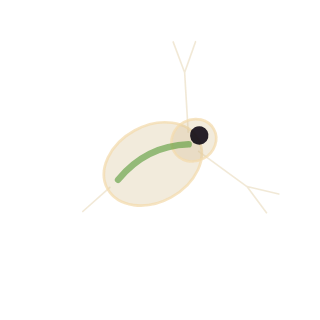 Water fleaDaphniaA tiny filter-feeding crustacean whose beating heart can be seen through its transparent shell.
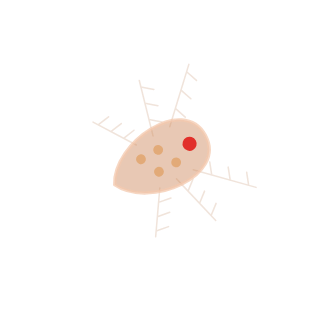 Nauplius larvaNauplius stage of crustaceansThe tiny one-eyed, three-pairs-of-limbs larva that hatches from the eggs of copepods, shrimp and barnacles.
This page is for general information; sizes and numbers vary by species, source and environment. The pictures are generated from the drawing code of the game Organizma and are simplified, game-like versions of the organisms. Bu sayfanın Türkçesi. Spotted a mistake? Let me know.