
A bell-shaped ciliate on a spring-like stalk that makes one of the fastest movements known in cells.
🦠 See it in Organizma and playFact file
| Scientific name | Vorticella |
|---|---|
| Group | Ciliates (Ciliophora) |
| Size | Body about 30–150 µm; the stalk several times longer |
| Habitat | Fresh water, attached to plants, stones and small animals |
| Feeding | Bacteria, drawn in by the current of the cilia around its mouth |
| Movement | Fixed to its stalk; the stalk contracts and relaxes |
| Reproduction | Binary fission; the daughter swims free and settles somewhere new |
How does it live?
The inverted-bell body of vorticella sits at the tip of a long, thin stalk. A ring of cilia at the mouth of the bell swirls the water and carries bacteria into the mouth.
Inside the stalk runs a contractile fibre called the spasmoneme. When the cell is disturbed, calcium triggers this fibre and the stalk coils like a spring in milliseconds, pulling the body down to the surface.
Fun facts
- Relative to its size, the stalk contraction is one of the fastest movements in the living world: the body pulls back at hundreds of body lengths per second.
- Because the spasmoneme runs on calcium rather than ATP, scientists study it as inspiration for artificial muscle designs.
- Plenty of vorticella in a wastewater treatment plant is a sign that aeration is working well.
In the game Organizma
In Organizma vorticellas sway in the water as micro-creatures with their stalks and bell bodies.
🦠 Play📺 Watch in screensaver modeGame vs. reality
- In the game: In the game organisms collect the genes of what they eat.
In reality: In reality genes are mostly passed from parent to offspring. Close parallels to getting genes from food are rare: horizontal gene transfer in bacteria, and a cell turning a swallowed alga into an organelle (endosymbiosis; this is how mitochondria and chloroplasts arose). - In the game: In the game you pick evolution cards while alive.
In reality: In reality an individual does not evolve during its life; mutations build up from generation to generation. The game's generation inheritance is therefore closer to reality.
Similar organisms
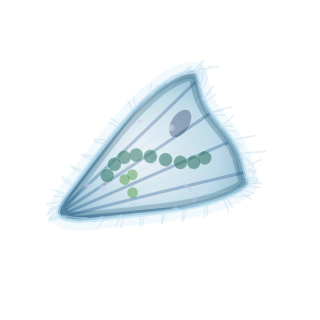 StentorStentor coeruleusA trumpet-shaped blue giant among single cells that stretches up to 2 millimetres and is visible to the naked eye.
 ParameciumParamecium caudatumA slipper-shaped single cell that swims by beating thousands of cilia like oars and sweeps bacteria into its oral groove.
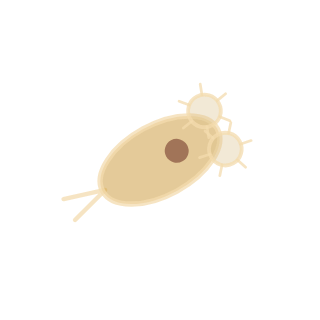 Rotifer (wheel animal)RotiferaA tiny animal whose ring of cilia looks like a spinning wheel, and which can survive frozen for thousands of years.
This page is for general information; sizes and numbers vary by species, source and environment. The pictures are generated from the drawing code of the game Organizma and are simplified, game-like versions of the organisms. Bu sayfanın Türkçesi. Spotted a mistake? Let me know.