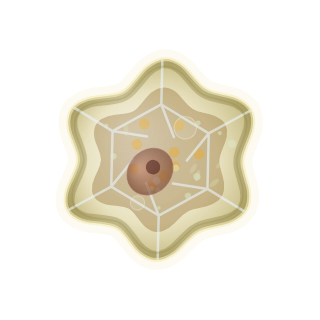
A tiny light-feeding flagellate alga that drifts in the sea on a star-shaped silica skeleton.
🦠 See it in Organizma and playFact file
| Scientific name | Dictyocha |
|---|---|
| Group | Silicoflagellates (Dictyochophyceae) |
| Size | About 20–100 µm |
| Habitat | Sea plankton, especially cold, nutrient-rich coastal waters |
| Feeding | Photosynthesis (golden-brown chloroplasts) |
| Movement | Slowly with a single flagellum; mostly drifts |
| Reproduction | Binary fission; it also has stages without a skeleton |
How does it live?
The silicoflagellate cell sits on a delicate skeleton made of silica: a ring with spines pointing outwards. This star-shaped skeleton keeps the cell light and helps it float without sinking.
It photosynthesises with golden-brown chloroplasts and is part of coastal plankton. Some species can cause problems on fish farms when they multiply greatly.
Fun facts
- Their fossils are known from the Cretaceous onwards; because the shape of their skeleton changes with water temperature, they help estimate the temperature of ancient seas.
- Like diatoms and radiolarians, it builds its skeleton from silica dissolved in the water.
- Some species both make food from light and swallow small particles in some stages.
In the game Organizma
In Organizma the Silicoflagellate species is drawn with its hexagonal silica skeleton and spines. As a marine organism it struggles in the fresh water of the estuary and is at ease in the open sea.
🦠 Play📺 Watch in screensaver modeGame vs. reality
- In the game: In the game organisms collect the genes of what they eat.
In reality: In reality genes are mostly passed from parent to offspring. Close parallels to getting genes from food are rare: horizontal gene transfer in bacteria, and a cell turning a swallowed alga into an organelle (endosymbiosis; this is how mitochondria and chloroplasts arose). - In the game: In the game you pick evolution cards while alive.
In reality: In reality an individual does not evolve during its life; mutations build up from generation to generation. The game's generation inheritance is therefore closer to reality.
Similar organisms
 RadiolarianRadiolariaAn elegant marine single cell with a glass skeleton that lasts for millions of years on the ocean floor.
 DiatomBacillariophytaAn alga that lives inside two halves of a glass box and produces a large share of Earth's oxygen.
 CoccolithophoreEmiliania huxleyi and relativesA tiny alga covered in chalk scales that turns the sea milky blue, visible from space, when it blooms.
This page is for general information; sizes and numbers vary by species, source and environment. The pictures are generated from the drawing code of the game Organizma and are simplified, game-like versions of the organisms. Bu sayfanın Türkçesi. Spotted a mistake? Let me know.