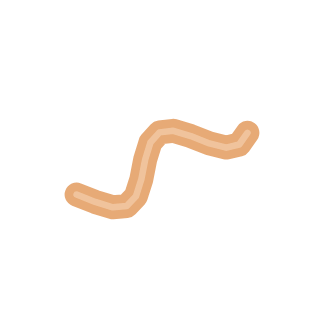
A corkscrew-shaped bacterium of still water that swims with tufts of flagella at both ends.
🦠 See it in Organizma and playFact file
| Scientific name | Spirillum volutans |
|---|---|
| Group | Bacteria (Pseudomonadota) |
| Size | About 14–60 µm long; one of the largest bacteria |
| Habitat | Still fresh water rich in organic matter |
| Feeding | Decomposes organic matter; prefers little oxygen (microaerophile) |
| Movement | Tufts of flagella at both ends; the body turns like a corkscrew |
| Reproduction | Binary fission |
How does it live?
The body of a spirillum is rigid and helical. When the flagella tufts at both ends spin together, the cell "screws" itself through the water like a corkscrew; it reverses them to change direction.
It likes neither oxygen-rich nor oxygen-free water and seeks the low-oxygen layer. In a drop of water they often gather in a band near the oxygen boundary.
Fun facts
- Spirillum volutans can reach 60 µm, dozens of times longer than most bacteria, and is easy to see with a light microscope.
- Spiral bacteria come in three shapes: rigid spirilla, flexible spirochetes and comma-shaped vibrios.
- In the 1680s Antoni van Leeuwenhoek was among the first to see spiral bacteria, in samples from between his teeth.
In the game Organizma
The spirilla in Organizma are micro-creatures that swim by spinning their twisted bodies.
🦠 Play📺 Watch in screensaver modeGame vs. reality
- In the game: In the game organisms collect the genes of what they eat.
In reality: In reality genes are mostly passed from parent to offspring. Close parallels to getting genes from food are rare: horizontal gene transfer in bacteria, and a cell turning a swallowed alga into an organelle (endosymbiosis; this is how mitochondria and chloroplasts arose). - In the game: In the game you pick evolution cards while alive.
In reality: In reality an individual does not evolve during its life; mutations build up from generation to generation. The game's generation inheritance is therefore closer to reality.
Similar organisms
 SpirocheteSpirochaetes (e.g. Leptospira)Flexible, long, thin spiral bacteria: their flagella are inside the body, so they move by twisting like a drill.
 Vibrio (comma bacterium)VibrioA comma-shaped bacterium of seas and estuaries that swims very fast with a single flagellum.
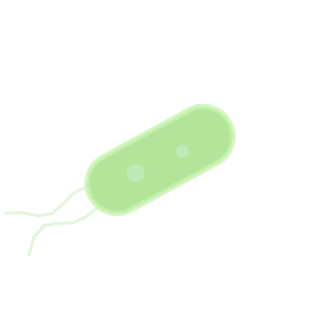 Bacillus (rod bacterium)Bacillus subtilisA rod-shaped bacterium of soil and water that turns into an almost indestructible spore in hard times.
This page is for general information; sizes and numbers vary by species, source and environment. The pictures are generated from the drawing code of the game Organizma and are simplified, game-like versions of the organisms. Bu sayfanın Türkçesi. Spotted a mistake? Let me know.