
A comma-shaped bacterium of seas and estuaries that swims very fast with a single flagellum.
🦠 See it in Organizma and playFact file
| Scientific name | Vibrio |
|---|---|
| Group | Bacteria (Pseudomonadota) |
| Size | About 1.5–3 µm long |
| Habitat | Sea and brackish water (estuaries); likes salt |
| Feeding | Organic matter, chitin (crustacean shells) |
| Movement | One polar flagellum; dozens of body lengths per second |
| Reproduction | Binary fission; very fast (every 10 minutes in some species) |
How does it live?
Vibrios are slightly curved, comma-like cells. By spinning their single flagellum very fast they become some of the fastest swimmers among bacteria.
Most live in seawater and estuaries, clinging to the chitin shells of copepods and other crustaceans. Some species glow; a few cause disease in humans.
Fun facts
- Cholera is caused by Vibrio cholerae; John Snow's 1854 linking of a London outbreak to a water pump is seen as the birth of epidemiology.
- Vibrio fischeri lives in the light organ of the Hawaiian bobtail squid and makes the light that gives it night-time "invisibility".
- Bacteria "talking" to each other with chemical signals (quorum sensing) was first discovered in glowing vibrios.
In the game Organizma
The vibrios in Organizma are fast comma-shaped micro-creatures, more common in the estuary near salt water.
🦠 Play📺 Watch in screensaver modeGame vs. reality
- In the game: In the game organisms collect the genes of what they eat.
In reality: In reality genes are mostly passed from parent to offspring. Close parallels to getting genes from food are rare: horizontal gene transfer in bacteria, and a cell turning a swallowed alga into an organelle (endosymbiosis; this is how mitochondria and chloroplasts arose). - In the game: In the game you pick evolution cards while alive.
In reality: In reality an individual does not evolve during its life; mutations build up from generation to generation. The game's generation inheritance is therefore closer to reality.
Similar organisms
 Spirillum (spiral bacterium)Spirillum volutansA corkscrew-shaped bacterium of still water that swims with tufts of flagella at both ends.
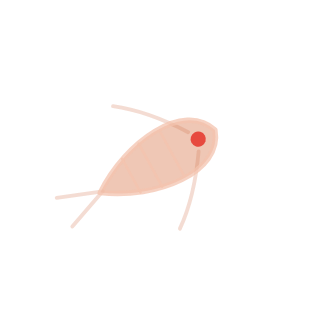 CopepodCopepodaA tiny one-eyed crustacean that is among the most numerous animals on Earth.
 Bacillus (rod bacterium)Bacillus subtilisA rod-shaped bacterium of soil and water that turns into an almost indestructible spore in hard times.
This page is for general information; sizes and numbers vary by species, source and environment. The pictures are generated from the drawing code of the game Organizma and are simplified, game-like versions of the organisms. Bu sayfanın Türkçesi. Spotted a mistake? Let me know.