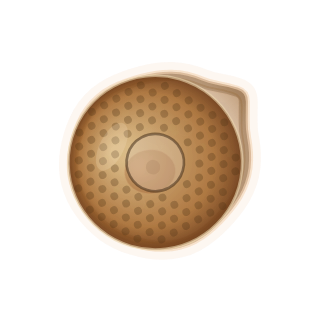
An amoeba that lives inside a house it secretes itself or builds from grains of sand.
🦠 See it in Organizma and playFact file
| Scientific name | Arcella and Difflugia |
|---|---|
| Group | Testate amoebae (Arcellinida) |
| Size | About 0.04–0.25 mm |
| Habitat | Peat bogs, mosses, lake bottoms and damp soil |
| Feeding | Bacteria, algae, fungal spores |
| Movement | Slowly, with pseudopods reaching out of the shell opening |
| Reproduction | Binary fission; the daughter builds a new shell |
How does it live?
The soft body of a testate amoeba sits inside a shell (test) with a single opening. Arcella builds its shell from protein plates it secretes; the shell turns from golden yellow to brown with age. Difflugia instead collects sand grains and diatom shells from its surroundings and glues them together.
The cell pushes its pseudopods out of the shell opening, grips the ground and drags its shell along. When it divides, a new shell is built for the daughter cell from material gathered in advance.
Fun facts
- Their shells survive for thousands of years; the species found in peat bogs tell scientists about past changes in moisture and climate.
- Arcella can make tiny gas bubbles inside the cell to rise and sink in the water.
- Some species pick only sand grains of a particular size: a single-celled "architect".
In the game Organizma
In Organizma the Testate amoeba species is tougher thanks to its hard shell, which works like armour against hits.
🦠 Play📺 Watch in screensaver modeGame vs. reality
- In the game: In the game organisms collect the genes of what they eat.
In reality: In reality genes are mostly passed from parent to offspring. Close parallels to getting genes from food are rare: horizontal gene transfer in bacteria, and a cell turning a swallowed alga into an organelle (endosymbiosis; this is how mitochondria and chloroplasts arose). - In the game: In the game you pick evolution cards while alive.
In reality: In reality an individual does not evolve during its life; mutations build up from generation to generation. The game's generation inheritance is therefore closer to reality.
Similar organisms
 AmoebaAmoeba proteusA single cell with no fixed shape that flows along on false feet and engulfs its prey.
 ForaminiferaForaminiferaA single cell with a chambered chalk shell that spreads web-like false feet through its holes; its fossils are even in the stones of the pyramids.
 RadiolarianRadiolariaAn elegant marine single cell with a glass skeleton that lasts for millions of years on the ocean floor.
This page is for general information; sizes and numbers vary by species, source and environment. The pictures are generated from the drawing code of the game Organizma and are simplified, game-like versions of the organisms. Bu sayfanın Türkçesi. Spotted a mistake? Let me know.