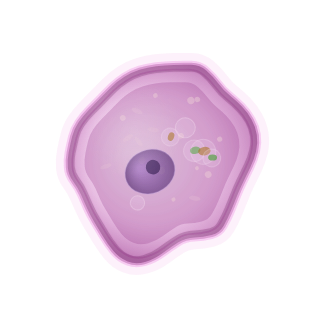
A single cell with no fixed shape that flows along on false feet and engulfs its prey.
🦠 See it in Organizma and playFact file
| Scientific name | Amoeba proteus |
|---|---|
| Group | Amoebae (Amoebozoa), single-celled eukaryote |
| Size | About 0.25–0.75 mm; large ones are visible to the naked eye as a dot |
| Habitat | Still fresh water, pond bottoms, decaying plant matter |
| Feeding | Engulfs bacteria, algae and small protists by phagocytosis |
| Movement | By extending pseudopods; very slow, about 0.1 mm per minute |
| Reproduction | Binary fission |
How does it live?
The body of an amoeba is jelly-like cytoplasm wrapped only in a thin cell membrane. The cell makes part of its cytoplasm flow forward, forming bulges called pseudopods (false feet); the rest of the cell flows in after them, and so the amoeba moves. Because its shape changes all the time, it is named after Proteus, the shape-shifting Greek sea god.
It hunts the same way: it extends two pseudopods around its prey, joins them behind it and traps the food inside a food vacuole. Digestive enzymes are released into the vacuole, the dissolved food passes into the cytoplasm, and waste is expelled through any part of the membrane.
Because it lives in fresh water, water constantly seeps into the cell. A pump-like sac called the contractile vacuole collects it and pushes it out; without it the cell would swell and burst.
Fun facts
- The giant amoeba Chaos carolinense can grow up to 5 millimetres and carries hundreds of nuclei.
- When food runs out or the water dries up, amoebae can turn into a thick-walled cyst and wait for a long time.
- Some amoeba relatives (such as Naegleria fowleri) can cause serious disease in humans; Amoeba proteus itself is harmless.
- Many of the first experiments on cell movement and phagocytosis were done with amoebae; the macrophages of our immune system swallow germs in a similar way.
In the game Organizma
In Organizma you can pick the Amoeba species: its membrane ripples constantly and it wraps food in its pseudopods. Being a freshwater cell, it loses water and shrinks when it enters salty water in the estuary. The occasional Giant amoeba is inspired by real giant amoebae, and the Mimivirus factory is an amoeba hijacked by giant viruses (in reality Mimivirus infects Acanthamoeba amoebae).
🦠 Play📺 Watch in screensaver modeGame vs. reality
- In the game: In the game organisms collect the genes of what they eat.
In reality: In reality genes are mostly passed from parent to offspring. Close parallels to getting genes from food are rare: horizontal gene transfer in bacteria, and a cell turning a swallowed alga into an organelle (endosymbiosis; this is how mitochondria and chloroplasts arose). - In the game: In the game you pick evolution cards while alive.
In reality: In reality an individual does not evolve during its life; mutations build up from generation to generation. The game's generation inheritance is therefore closer to reality.
Similar organisms
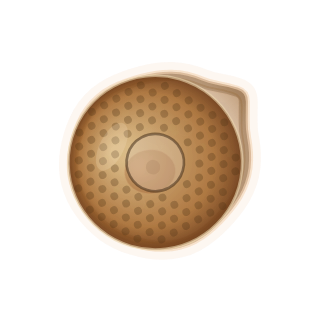 Testate amoebaArcella and DifflugiaAn amoeba that lives inside a house it secretes itself or builds from grains of sand.
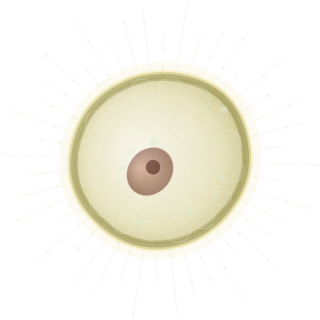 Heliozoan (sun animalcule)Actinosphaerium and ActinophrysA single cell that looks like a little sun with thin rays in every direction, and catches its prey with those rays.
 ParameciumParamecium caudatumA slipper-shaped single cell that swims by beating thousands of cilia like oars and sweeps bacteria into its oral groove.
This page is for general information; sizes and numbers vary by species, source and environment. The pictures are generated from the drawing code of the game Organizma and are simplified, game-like versions of the organisms. Bu sayfanın Türkçesi. Spotted a mistake? Let me know.