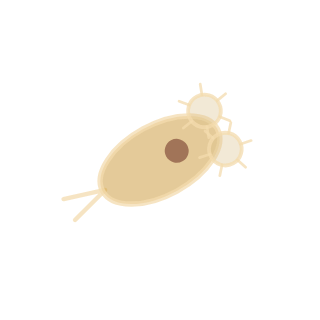
A tiny animal whose ring of cilia looks like a spinning wheel, and which can survive frozen for thousands of years.
🦠 See it in Organizma and playFact file
| Scientific name | Rotifera |
|---|---|
| Group | Rotifera (wheel animals) |
| Size | Mostly 0.1–0.5 mm |
| Habitat | Fresh water, mosses, damp soil; some in the sea |
| Feeding | Bacteria, algae and organic debris |
| Movement | Swims with its ring of cilia or crawls like a leech |
| Reproduction | Mostly females reproducing without males |
How does it live?
On the head of a rotifer are two rings of cilia called the corona, which look like a turning wheel. These cilia both make the animal swim and sweep food towards its mouth.
Behind the mouth, a muscular jaw apparatus called the mastax grinds the food. Although its body has only about a thousand cells, it has real organs such as a brain, a digestive system and an excretory system.
Fun facts
- Bdelloid rotifers have reproduced without males, with females only, for tens of millions of years.
- In 2021 rotifers taken from Siberian soil that had been frozen for 24,000 years were reported to revive and reproduce.
- When it dries out it can lose almost all its water and go into a "dry sleep", coming back to life when wetted.
In the game Organizma
In Organizma rotifers swim through the water as micro-creatures, drawn with their spinning corona wheel.
🦠 Play📺 Watch in screensaver modeGame vs. reality
- In the game: In the game organisms collect the genes of what they eat.
In reality: In reality genes are mostly passed from parent to offspring. Close parallels to getting genes from food are rare: horizontal gene transfer in bacteria, and a cell turning a swallowed alga into an organelle (endosymbiosis; this is how mitochondria and chloroplasts arose). - In the game: In the game you pick evolution cards while alive.
In reality: In reality an individual does not evolve during its life; mutations build up from generation to generation. The game's generation inheritance is therefore closer to reality.
Similar organisms
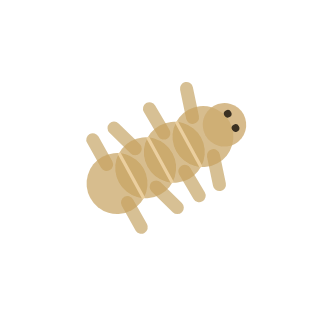 Tardigrade (water bear)TardigradaThe toughest animal on Earth: eight chubby legs, and able to survive drying, freezing and outer space.
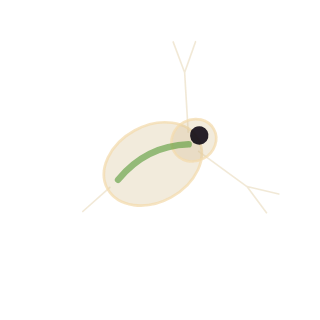 Water fleaDaphniaA tiny filter-feeding crustacean whose beating heart can be seen through its transparent shell.
 Vorticella (bell animalcule)VorticellaA bell-shaped ciliate on a spring-like stalk that makes one of the fastest movements known in cells.
This page is for general information; sizes and numbers vary by species, source and environment. The pictures are generated from the drawing code of the game Organizma and are simplified, game-like versions of the organisms. Bu sayfanın Türkçesi. Spotted a mistake? Let me know.