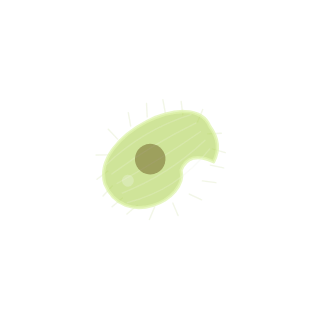
A kidney-shaped ciliate of soil water films that turns into a cyst within minutes when it dries out.
🦠 See it in Organizma and playFact file
| Scientific name | Colpoda |
|---|---|
| Group | Ciliates (Ciliophora) |
| Size | About 15–110 µm |
| Habitat | Soil, moss, hay infusions |
| Feeding | Bacteria |
| Movement | Fast and wobbly, with its cilia |
| Reproduction | Divides into 2–8 cells inside a cyst |
How does it live?
Colpoda lives in the thin films of water between soil grains. When the soil starts to dry, it quickly rounds up into a thick-walled cyst; when it rains, it hatches within minutes to hours.
It uses cysts to reproduce as well: the cell first forms a "division cyst", two, four or eight daughters form inside, and then they all swim off together.
Fun facts
- It is among the first ciliates to appear a few days after adding water to dry hay, which is why people in the 17th–19th centuries thought life arose spontaneously from non-living matter.
- Its cysts can stay dry for years.
- Its name comes from the Greek kolpos, "fold, bay", describing the shape of its mouth groove.
In the game Organizma
The colpodas in Organizma are small, fast ciliate micro-creatures. The game's cyst ability (K key) is best seen in real life in colpodas.
🦠 Play📺 Watch in screensaver modeGame vs. reality
- In the game: In the game organisms collect the genes of what they eat.
In reality: In reality genes are mostly passed from parent to offspring. Close parallels to getting genes from food are rare: horizontal gene transfer in bacteria, and a cell turning a swallowed alga into an organelle (endosymbiosis; this is how mitochondria and chloroplasts arose). - In the game: In the game you pick evolution cards while alive.
In reality: In reality an individual does not evolve during its life; mutations build up from generation to generation. The game's generation inheritance is therefore closer to reality.
Similar organisms
 ParameciumParamecium caudatumA slipper-shaped single cell that swims by beating thousands of cilia like oars and sweeps bacteria into its oral groove.
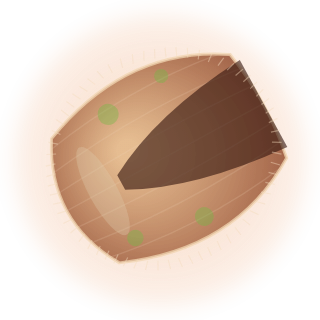 Bursaria (giant purse ciliate)Bursaria truncatellaA purse-shaped single-celled giant approaching a millimetre that swallows other ciliates whole with its huge mouth.
 Vorticella (bell animalcule)VorticellaA bell-shaped ciliate on a spring-like stalk that makes one of the fastest movements known in cells.
This page is for general information; sizes and numbers vary by species, source and environment. The pictures are generated from the drawing code of the game Organizma and are simplified, game-like versions of the organisms. Bu sayfanın Türkçesi. Spotted a mistake? Let me know.