
A tiny eight-armed, star-shaped baby jellyfish that breaks off a polyp and starts swimming.
🦠 See it in Organizma and playFact file
| Scientific name | Ephyra of Aurelia aurita |
|---|---|
| Group | Cnidarians (Cnidaria), Scyphozoa |
| Size | About 1–3 mm when released |
| Habitat | Coastal seas; in the plankton in spring |
| Feeding | Small zooplankton, copepods |
| Movement | Pulsing by contracting and relaxing its arms |
| Reproduction | The polyp splits into a stack of discs that break off as ephyrae |
How does it live?
A jellyfish's life has two parts: a small polyp stuck to the seabed and a free-swimming medusa. In spring the polyp splits like a stack of plates (strobilation) and each plate breaks off as an ephyra.
The ephyra looks like an eight-armed star; it pulses its arms rhythmically to move and catches small animals such as copepods. Within weeks it grows into a bell-shaped jellyfish.
Fun facts
- A single polyp can release dozens of ephyrae in spring, which is why jellyfish blooms start so suddenly.
- The medusa of some jellyfish can turn back into a polyp in hard times (Turritopsis, the "immortal jellyfish").
- It belongs to the same large group as hydra and carries stinging cells (cnidocytes).
In the game Organizma
The ephyrae in Organizma are eight-armed, pulsing micro-creatures that live in the sea (the outer ring).
🦠 Play📺 Watch in screensaver modeGame vs. reality
- In the game: In the game organisms collect the genes of what they eat.
In reality: In reality genes are mostly passed from parent to offspring. Close parallels to getting genes from food are rare: horizontal gene transfer in bacteria, and a cell turning a swallowed alga into an organelle (endosymbiosis; this is how mitochondria and chloroplasts arose). - In the game: In the game you pick evolution cards while alive.
In reality: In reality an individual does not evolve during its life; mutations build up from generation to generation. The game's generation inheritance is therefore closer to reality.
Similar organisms
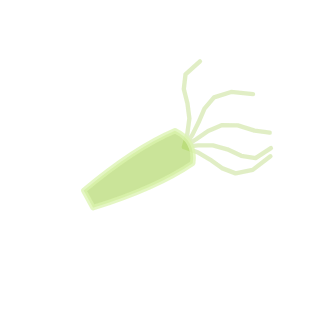 HydraHydraA tiny freshwater animal that hunts with venomous capsules on its tentacles and is thought not to age.
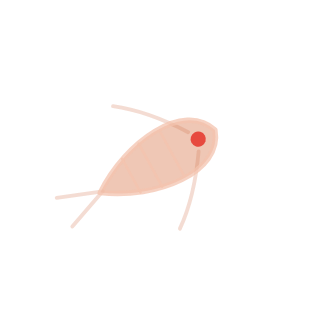 CopepodCopepodaA tiny one-eyed crustacean that is among the most numerous animals on Earth.
 Noctiluca (sea sparkle)Noctiluca scintillansA giant dinoflagellate that flashes blue light when disturbed and makes waves glow at night.
This page is for general information; sizes and numbers vary by species, source and environment. The pictures are generated from the drawing code of the game Organizma and are simplified, game-like versions of the organisms. Bu sayfanın Türkçesi. Spotted a mistake? Let me know.