
A giant amoeba up to five millimetres long with hundreds of nuclei, visible to the naked eye.
🦠 See it in Organizma and playFact file
| Scientific name | Chaos carolinense |
|---|---|
| Group | Amoebae (Amoebozoa) |
| Size | 1–5 mm |
| Habitat | Bottoms of clean ponds, decaying plants |
| Feeding | Ciliates, algae, small animals |
| Movement | With many pseudopods |
| Reproduction | Division; all nuclei divide at the same time |
How does it live?
Chaos carolinense is a single cell, yet it can hold hundreds or even over a thousand nuclei. A single nucleus could not run every part of such a large cell, so having many nuclei is what lets it grow so big.
It moves by extending many pseudopods at once and wraps its prey between them. When it divides, all its nuclei divide together and the cell splits into two, sometimes three, parts.
Fun facts
- The "little Proteus" drawn by Rösel von Rosenhof in the 18th century and the organism Linnaeus named Chaos are linked to these giant amoebae.
- To the eye it looks like a speck of dust; with a magnifier you can watch it move.
- It is a relative of Amoeba proteus, but several times bigger.
In the game Organizma
The Giant amoeba in Organizma is one of the rare giants; defeating it is a big achievement.
🦠 Play📺 Watch in screensaver modeGame vs. reality
- In the game: In the game organisms collect the genes of what they eat.
In reality: In reality genes are mostly passed from parent to offspring. Close parallels to getting genes from food are rare: horizontal gene transfer in bacteria, and a cell turning a swallowed alga into an organelle (endosymbiosis; this is how mitochondria and chloroplasts arose). - In the game: In the game you pick evolution cards while alive.
In reality: In reality an individual does not evolve during its life; mutations build up from generation to generation. The game's generation inheritance is therefore closer to reality.
Similar organisms
 AmoebaAmoeba proteusA single cell with no fixed shape that flows along on false feet and engulfs its prey.
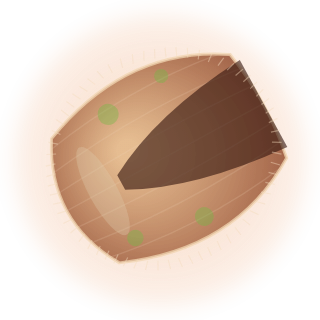 Bursaria (giant purse ciliate)Bursaria truncatellaA purse-shaped single-celled giant approaching a millimetre that swallows other ciliates whole with its huge mouth.
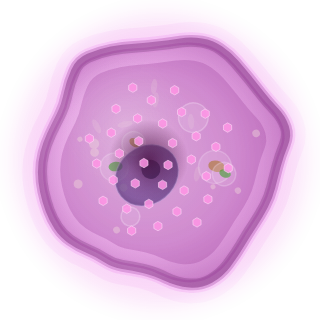 Mimivirus (giant virus)Acanthamoeba polyphaga mimivirusA giant virus big enough to see with a light microscope, once mistaken for a bacterium; it multiplies inside amoebae.
This page is for general information; sizes and numbers vary by species, source and environment. The pictures are generated from the drawing code of the game Organizma and are simplified, game-like versions of the organisms. Bu sayfanın Türkçesi. Spotted a mistake? Let me know.