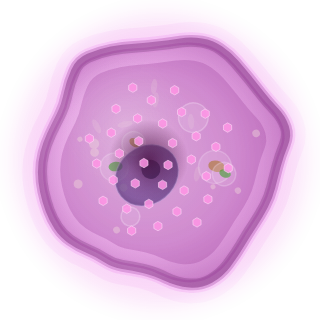
A giant virus big enough to see with a light microscope, once mistaken for a bacterium; it multiplies inside amoebae.
🦠 See it in Organizma and playFact file
| Scientific name | Acanthamoeba polyphaga mimivirus |
|---|---|
| Group | Giant viruses (Nucleocytoviricota) |
| Size | About 0.75 µm including its fibres |
| Habitat | Water; its host is the amoeba Acanthamoeba |
| Feeding | None; uses the host cell |
| Movement | None |
| Reproduction | Builds a "virus factory" inside the amoeba |
How does it live?
Mimivirus was found in 1992 inside amoebae from a cooling tower and was long thought to be a bacterium. When it was recognised as a virus in 2003, it was the largest virus known.
The amoeba swallows it, taking it for food. Inside, the virus builds a large virus factory that copies its genetic material; when hundreds of new viruses have formed, the amoeba bursts.
Fun facts
- Its genome has over a million base pairs and around a thousand genes, more than some bacteria.
- Its name means "mimicking microbe".
- A smaller virus called Sputnik "sneaks into" the mimivirus factory to multiply: even viruses have viruses.
In the game Organizma
The Mimivirus factory in Organizma is an amoeba taken over by giant viruses: it makes viruses inside and scatters them into the water when it bursts, exactly as in reality.
🦠 Play📺 Watch in screensaver modeGame vs. reality
- In the game: In the game organisms collect the genes of what they eat.
In reality: In reality genes are mostly passed from parent to offspring. Close parallels to getting genes from food are rare: horizontal gene transfer in bacteria, and a cell turning a swallowed alga into an organelle (endosymbiosis; this is how mitochondria and chloroplasts arose). - In the game: In the game you pick evolution cards while alive.
In reality: In reality an individual does not evolve during its life; mutations build up from generation to generation. The game's generation inheritance is therefore closer to reality.
Similar organisms
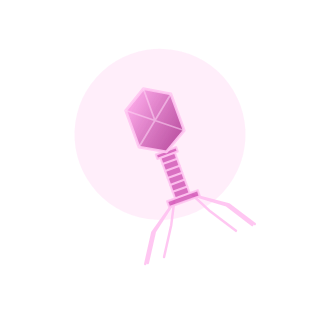 Virus and bacteriophageViruses, e.g. phage T4Cannot multiply on its own, enters a cell and takes over its machinery; the most numerous biological entity on Earth.
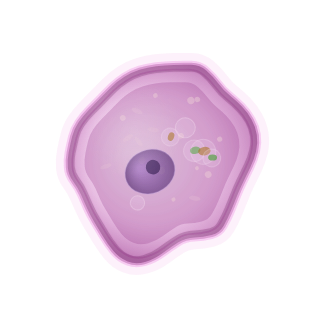 AmoebaAmoeba proteusA single cell with no fixed shape that flows along on false feet and engulfs its prey.
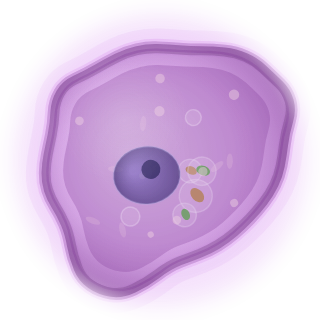 Giant amoeba (Chaos)Chaos carolinenseA giant amoeba up to five millimetres long with hundreds of nuclei, visible to the naked eye.
This page is for general information; sizes and numbers vary by species, source and environment. The pictures are generated from the drawing code of the game Organizma and are simplified, game-like versions of the organisms. Bu sayfanın Türkçesi. Spotted a mistake? Let me know.