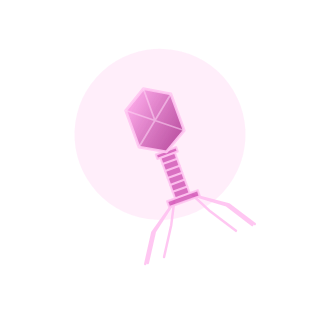
Cannot multiply on its own, enters a cell and takes over its machinery; the most numerous biological entity on Earth.
🦠 See it in Organizma and playFact file
| Scientific name | Viruses, e.g. phage T4 |
|---|---|
| Group | Viruses (non-cellular) |
| Size | About 20–300 nm; phage T4 about 200 nm (one 5,000th of a millimetre) |
| Habitat | Wherever host cells are; millions in every millilitre of seawater |
| Feeding | None; it has no metabolism |
| Movement | None of its own; carried by water and hosts |
| Reproduction | Only inside a host cell, using its machinery |
How does it live?
A virus is basically genetic material (DNA or RNA) packed inside a protein coat. Bacteriophages (phages), the viruses that infect bacteria, often look like a lunar lander: a geometric head, a tail and leg fibres.
The phage recognises the right bacterium with its tail fibres, latches onto its surface and injects its genetic material into the cell like a syringe. The cell drops its own work and makes hundreds of new viruses, finally bursting to release them.
Fun facts
- There are an estimated 1031 phages on Earth: far more than the number of stars in the universe.
- Marine viruses are thought to kill a large share (perhaps 20–40%) of the ocean's bacteria every day; the released nutrients go back into the plankton.
- Phage therapy, which uses phages as medicine against antibiotic-resistant infections, is being researched again.
In the game Organizma
The pink viruses in Organizma cannot swim, just as in reality; they drift with the water, stick to a big cell they hit and multiply inside it. While small, you can eat them. Among the giants, the Mimivirus factory is an amoeba taken over by giant viruses: it makes viruses inside and releases them into the water as it bursts. The Virus outbreak event comes from here too.
🦠 Play📺 Watch in screensaver modeGame vs. reality
- In the game: In the game you can shake viruses off with a dash.
In reality: In reality once a virus is inside a cell, there is no escape except the cell's own defences (or systems like CRISPR in bacteria). - In the game: In the game small cells can eat viruses.
In reality: This is real: some single cells (such as the ciliate Halteria) can eat viruses as food; this was shown in 2022. - In the game: In the game organisms collect the genes of what they eat.
In reality: In reality genes are mostly passed from parent to offspring. Close parallels to getting genes from food are rare: horizontal gene transfer in bacteria, and a cell turning a swallowed alga into an organelle (endosymbiosis; this is how mitochondria and chloroplasts arose). - In the game: In the game you pick evolution cards while alive.
In reality: In reality an individual does not evolve during its life; mutations build up from generation to generation. The game's generation inheritance is therefore closer to reality.
Similar organisms
 DidiniumDidinium nasutumA barrel-shaped hunter that catches paramecia bigger than itself with a toxic snout and swallows them whole.
 DiatomBacillariophytaAn alga that lives inside two halves of a glass box and produces a large share of Earth's oxygen.
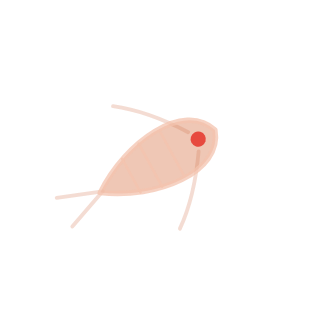 CopepodCopepodaA tiny one-eyed crustacean that is among the most numerous animals on Earth.
This page is for general information; sizes and numbers vary by species, source and environment. The pictures are generated from the drawing code of the game Organizma and are simplified, game-like versions of the organisms. Bu sayfanın Türkçesi. Spotted a mistake? Let me know.