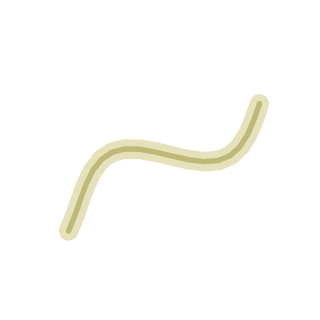
One of the most numerous animal groups on Earth: thousands wriggle in a handful of soil.
🦠 See it in Organizma and playFact file
| Scientific name | Nematoda (e.g. Caenorhabditis elegans) |
|---|---|
| Group | Roundworms (Nematoda) |
| Size | Most free-living ones 0.2–2 mm |
| Habitat | Soil, fresh water, the seabed; some are parasites |
| Feeding | Bacteria, fungi, algae; some are predators |
| Movement | Bending the body into an S; it only has lengthwise muscles |
| Reproduction | Sexual; some species are self-fertilising hermaphrodites |
How does it live?
Nematodes have thin, unsegmented bodies pointed at both ends. With only lengthwise muscles they can move only by bending from side to side, drawing S shapes like a snake.
Soil nematodes graze on bacteria and fungi and speed up the nutrient cycle. Some are parasites of plants or animals.
Fun facts
- Caenorhabditis elegans was the first animal whose entire nervous-system wiring map was drawn; a hermaphrodite has exactly 302 nerve cells.
- The total number of soil nematodes on Earth has been estimated at about 4.4 × 10²⁰.
- Some nematodes can dry out and wait like tardigrades; nematodes frozen in Siberian permafrost for about 46,000 years were reported to revive.
In the game Organizma
The nematodes in Organizma are thin worms that wriggle in S shapes.
🦠 Play📺 Watch in screensaver modeGame vs. reality
- In the game: In the game organisms collect the genes of what they eat.
In reality: In reality genes are mostly passed from parent to offspring. Close parallels to getting genes from food are rare: horizontal gene transfer in bacteria, and a cell turning a swallowed alga into an organelle (endosymbiosis; this is how mitochondria and chloroplasts arose). - In the game: In the game you pick evolution cards while alive.
In reality: In reality an individual does not evolve during its life; mutations build up from generation to generation. The game's generation inheritance is therefore closer to reality.
Similar organisms
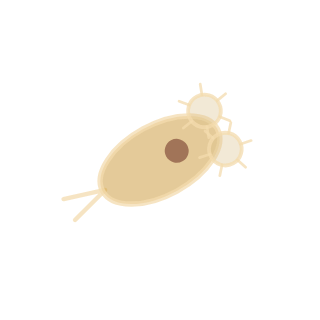 Rotifer (wheel animal)RotiferaA tiny animal whose ring of cilia looks like a spinning wheel, and which can survive frozen for thousands of years.
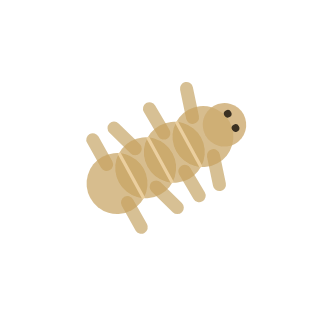 Tardigrade (water bear)TardigradaThe toughest animal on Earth: eight chubby legs, and able to survive drying, freezing and outer space.
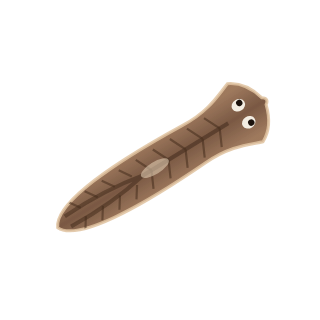 Planarian (flatworm)Dugesia (Schmidtea)A flatworm with two cross-eyed eyespots that can regrow a whole animal from almost any piece.
This page is for general information; sizes and numbers vary by species, source and environment. The pictures are generated from the drawing code of the game Organizma and are simplified, game-like versions of the organisms. Bu sayfanın Türkçesi. Spotted a mistake? Let me know.