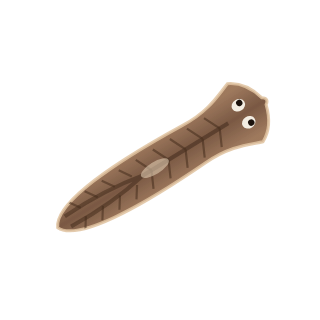
A flatworm with two cross-eyed eyespots that can regrow a whole animal from almost any piece.
🦠 See it in Organizma and playFact file
| Scientific name | Dugesia (Schmidtea) |
|---|---|
| Group | Flatworms (Platyhelminthes) |
| Size | 3–20 mm |
| Habitat | Under stones in clean streams and ponds |
| Feeding | Small crustaceans, worms, dead animals |
| Movement | Glides on belly cilia over the mucus it secretes |
| Reproduction | Splitting itself in two, or sexual (hermaphrodite) |
How does it live?
A planarian's head has two light-sensitive eyespots that give it a cross-eyed face. It avoids light and hides under stones.
Its mouth is in the middle of its belly; it pushes out its pharynx like a tube to suck up food. Stem cells spread all over its body (neoblasts) give it an incredible power of regeneration.
Fun facts
- Even if a planarian is cut into hundreds of pieces, each piece can become a new worm; in the 1890s Thomas Hunt Morgan reported that a fragment 1/279 of the body could form a whole animal.
- It is one of the most important model animals in regeneration and stem-cell research.
- It is not microscopic, but often turns up with micro-creatures in pond samples.
In the game Organizma
Planarians are not in Organizma; small worm-like creatures such as nematodes and rotifers are.
🦠 Play📺 Watch in screensaver modeGame vs. reality
- In the game: In the game organisms collect the genes of what they eat.
In reality: In reality genes are mostly passed from parent to offspring. Close parallels to getting genes from food are rare: horizontal gene transfer in bacteria, and a cell turning a swallowed alga into an organelle (endosymbiosis; this is how mitochondria and chloroplasts arose). - In the game: In the game you pick evolution cards while alive.
In reality: In reality an individual does not evolve during its life; mutations build up from generation to generation. The game's generation inheritance is therefore closer to reality.
Similar organisms
 Nematode (roundworm)Nematoda (e.g. Caenorhabditis elegans)One of the most numerous animal groups on Earth: thousands wriggle in a handful of soil.
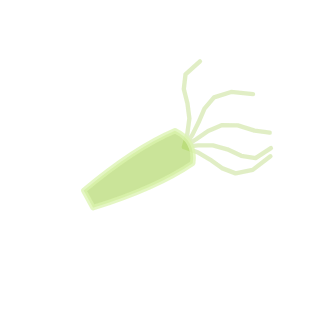 HydraHydraA tiny freshwater animal that hunts with venomous capsules on its tentacles and is thought not to age.
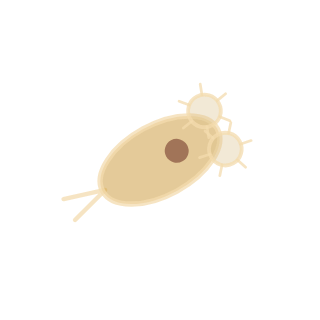 Rotifer (wheel animal)RotiferaA tiny animal whose ring of cilia looks like a spinning wheel, and which can survive frozen for thousands of years.
This page is for general information; sizes and numbers vary by species, source and environment. The pictures are generated from the drawing code of the game Organizma and are simplified, game-like versions of the organisms. Bu sayfanın Türkçesi. Spotted a mistake? Let me know.