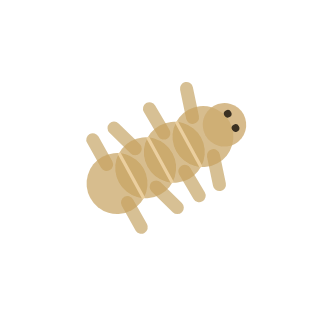
The toughest animal on Earth: eight chubby legs, and able to survive drying, freezing and outer space.
🦠 See it in Organizma and playFact file
| Scientific name | Tardigrada |
|---|---|
| Group | Tardigrada (water bears) |
| Size | Mostly 0.3–0.5 mm; the largest 1.2 mm |
| Habitat | The water film on mosses and lichens, soil, sea sand; from the Himalayas to the deep sea |
| Feeding | Plant cell sap, algae, bacteria; some are predators |
| Movement | Walks slowly on eight clawed legs |
| Reproduction | Mostly sexual; eggs |
How does it live?
Tardigrades pierce moss cells with the sharp stylets in their mouth and suck out the contents. Their slow, lumbering walk earned them the names "water bear" and, in Latin, "slow stepper" (tardigrada).
Their real fame comes from their toughness. When their surroundings dry out they pull in their legs, shrivel into a barrel shape called a tun and almost stop their metabolism. In this state of cryptobiosis they can wait for years; given water, they revive within minutes.
Fun facts
- In 2007 tardigrades were sent into open space on the FOTON-M3 satellite; some survived and laid eggs after returning to Earth.
- Experiments showed that in the tun state they can survive cold close to absolute zero, temperatures above 100 °C for short periods and radiation hundreds of times the lethal human dose.
- The Dsup protein found in some species protects DNA from radiation damage; it also gave protection when transferred into human cells.
In the game Organizma
In Organizma tardigrades walk on eight legs as micro-creatures; eating one adds a rarely seen gene to your gene book.
🦠 Play📺 Watch in screensaver modeGame vs. reality
- In the game: In the game organisms collect the genes of what they eat.
In reality: In reality genes are mostly passed from parent to offspring. Close parallels to getting genes from food are rare: horizontal gene transfer in bacteria, and a cell turning a swallowed alga into an organelle (endosymbiosis; this is how mitochondria and chloroplasts arose). - In the game: In the game you pick evolution cards while alive.
In reality: In reality an individual does not evolve during its life; mutations build up from generation to generation. The game's generation inheritance is therefore closer to reality.
Similar organisms
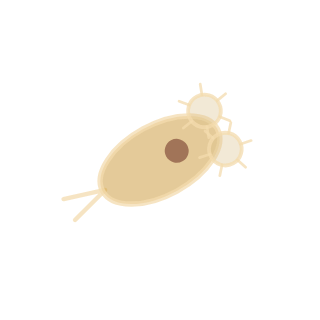 Rotifer (wheel animal)RotiferaA tiny animal whose ring of cilia looks like a spinning wheel, and which can survive frozen for thousands of years.
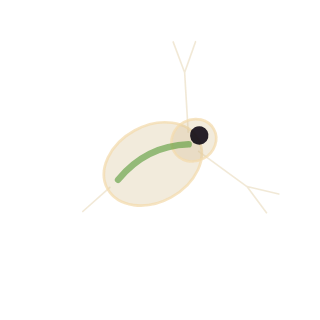 Water fleaDaphniaA tiny filter-feeding crustacean whose beating heart can be seen through its transparent shell.
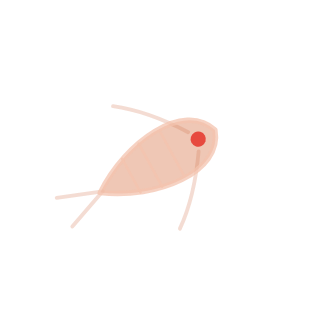 CopepodCopepodaA tiny one-eyed crustacean that is among the most numerous animals on Earth.
This page is for general information; sizes and numbers vary by species, source and environment. The pictures are generated from the drawing code of the game Organizma and are simplified, game-like versions of the organisms. Bu sayfanın Türkçesi. Spotted a mistake? Let me know.